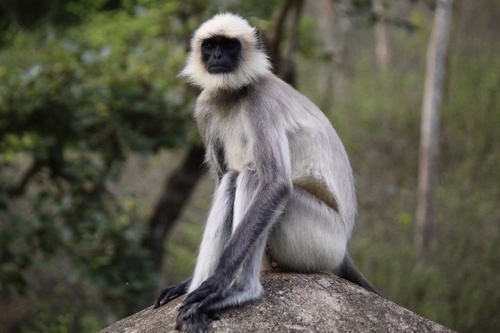
Malabar Sacred Langur
Semnopithecus hypoleucos
Recognizable by its striking black 'socks' and silver-gray coat, the Malabar Sacred Langur is a majestic primate of India's Western Ghats. These athletic acrobats are as comfortable leaping through the rainforest canopy as they are lounging in a backyard garden.
Quick Identification
Size
Head-body length of 50-70 cm (20-28 in); tail length of 70-100 cm (28-39 in); weight typically 10-18 kg (22-40 lbs).
Colors
Silvery-gray to buff body fur with contrasting black hands and feet; face is hairless and black, framed by a pale yellowish-white ruff.
Key Features
- Distinctive black 'socks' on hands and feet
- Extraordinarily long tail held in a forward-arching loop
- Black hairless face with prominent brow ridges
- Stiff, backward-pointing hair on the crown forming a hood
When You’ll See Them
Geographic range
Where Does the Malabar Sacred Langur Live?
Native to the Asian continent, the Malabar Sacred Langur is a specialized resident of southwestern India. Its core range is strictly limited to the Western Ghats mountain range, spanning from the state of Goa southward through Karnataka, Kerala, and into the western reaches of Tamil Nadu. This species thrives in the high-rainfall zones and lush coastal forests that define the Malabar Coast region.
Basemap © OpenStreetMap contributors
Behavior
The Malabar Sacred Langur is a highly social primate, typically found in troops ranging from 10 to 30 individuals. These groups are usually led by a dominant male, though multi-male groups are also common. They are largely arboreal, spending their nights high in the forest canopy for safety, but they are surprisingly comfortable on the ground, where they can be seen walking with a confident, four-legged gait or lounging in the shade during the heat of the day.
Known for their gentle temperament compared to macaques, these langurs have a complex communication system involving loud 'whoops' that can carry for over a kilometer through dense forest. In areas near human settlements, they have developed a wary but somewhat tolerant relationship with people. Because they are considered sacred in many local traditions, they are rarely hunted and will often visit backyard gardens or temple grounds in search of easy foraging opportunities.
EverydayEarth exclusive
Camera Tips
To capture the Malabar Sacred Langur on a trail camera, placement is everything. Since they are semi-arboreal, mounting your camera 4 to 6 feet high on a sturdy trunk facing a known 'commuter' branch or a clear forest path is most effective. Look for 'langur highways'—consistent routes they use to descend from the canopy to reach water sources or fruit trees. Angle the camera slightly downward to catch them as they forage on the ground for fallen fruits.
Because these monkeys travel in large troops, set your camera to 'Burst Mode' or 'Photo + Video.' A single shot will likely catch the scout, but the best footage comes from the mothers with infants and the playful juveniles that follow several minutes later. High-speed triggers are essential, as their leaps between branches can be incredibly fast, often resulting in motion blur on cheaper sensors.
While we don't recommend artificial baiting with human food, which can cause health issues and aggression, placing a camera near a fruiting Wild Mango or Jackfruit tree during the dry season is a natural lure. Langurs are highly intelligent and curious; they may notice the camera lens. Use a camouflage housing and ensure the 'no-glow' infrared flash is enabled to prevent startling the troop, which could lead to them avoiding the area or, worse, a curious juvenile trying to dismantle your equipment.
Similar Species
Species that look similar or are commonly confused with Malabar Sacred Langur.
Frequently Asked Questions
Record Malabar Sacred Langur at your habitat
Connect a camera to start building your own species record — AI identifies every visitor automatically.