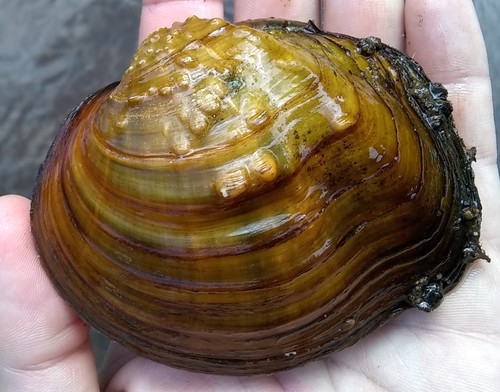
Mapleleaf
Quadrula quadrula
A silent guardian of our waterways, the Mapleleaf mussel is a master of filtration with a shell that looks like a piece of living river-art. This resilient bivalve plays a crucial role in maintaining the clarity and health of North American river systems.
Quick Identification
Size
Typically 5–12 cm (2–5 inches) in length, with a shell height often equal to its length.
Colors
Yellowish-green to light tan in juveniles, darkening to a rich brown or mahogany as they age; interior shell (nacre) is pearly white.
Key Features
- Distinctly square or 'quadrate' shell shape
- Two vertical rows of raised nodules (pustules) separated by a shallow groove
- Heavy, thick-walled shell with prominent S-shaped growth lines
- V-shaped green rays often visible on younger individuals
When You’ll See Them
Geographic range
Where Does the Mapleleaf Live?
Native to the North American continent, the Mapleleaf is primarily found throughout the expansive Mississippi River drainage basin. Its core range spans the central United States from the Great Lakes and St. Lawrence River system in the north down to the Gulf of Mexico, extending as far west as Texas and Oklahoma. While common in the heart of its range, northern populations in Canada are considered more sensitive and are closely monitored by conservationists.
Basemap © OpenStreetMap contributors
Behavior
The Mapleleaf is a sedentary filter feeder that spends the majority of its long life partially buried in the substrate of riverbeds and lake bottoms. It acts as a vital ecological engineer, siphoning gallons of water every day to extract microscopic nutrients. By doing so, it effectively cleans the water and provides a stable habitat for other aquatic organisms. While they may appear as motionless as stones, these mussels use a muscular 'foot' to slowly anchor themselves or move short distances to find optimal water flow.
The reproductive strategy of the Mapleleaf is one of nature's most complex cycles. They rely on a specific host—typically the Channel Catfish or Flathead Catfish—to complete their life cycle. The female releases specialized larvae called glochidia, which must attach to the gills of a passing fish. These tiny hitchhikers travel with the fish for several weeks before dropping off as juvenile mussels to begin their independent lives. This dependency makes the Mapleleaf an indicator species for the health of both the water and local fish populations.
EverydayEarth exclusive
Camera Tips
Documenting a Mapleleaf with an AI-powered camera requires shifting your focus underwater. Because these mussels are aquatic and largely stationary, the most effective setup is an underwater action camera or a waterproof trail camera placed in shallow, clear water. Look for 'mussel beds'—areas of river with stable sand or gravel bars. Secure your camera to a heavy baseplate or a flat river stone to keep it from drifting in the current, and position it at a 45-degree angle to the substrate to capture the texture of the shell pustules and the opening of the siphons.
For the most engaging footage, use a time-lapse setting rather than standard motion-activated video. Over a 12-to-24-hour period, a time-lapse will reveal the Mapleleaf's subtle but fascinating movements: the 'breathing' of the shell as it opens to feed and the slow, deliberate furrowing through the sand as it adjusts its position. Since mussels don't respond to food bait, 'bait' your camera by placing it near woody debris or structures that naturally attract catfish, their primary host species, to capture the full ecological story.
Clarity is the biggest variable for success. Plan your camera deployments during the summer when water levels are low and currents are slower, which minimizes suspended silt. If you are shooting in a backyard creek, wait for at least three days after a rain event for the sediment to settle. Using a polarizing filter on your lens (even in a waterproof housing) can significantly reduce surface glare if you are positioned in very shallow water, allowing the AI to better distinguish the shell from the surrounding riverbed.
Similar Species
Species that look similar or are commonly confused with Mapleleaf.
Frequently Asked Questions
Record Mapleleaf at your habitat
Connect a camera to start building your own species record — AI identifies every visitor automatically.