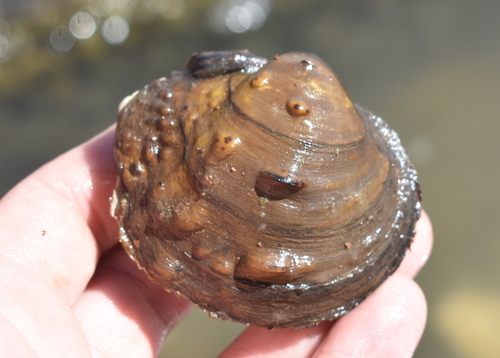
Wartyback
Pustulosa nodulata
A rugged and resilient filter feeder, the Wartyback is an essential architect of North American river ecosystems. Known for its 'bumpy' shell and vital water-purifying abilities, this mussel is a hidden gem of our central waterways.
Quick Identification
Size
2 to 3 inches (5 to 7.5 cm) in length; weight is negligible as shells vary in thickness
Colors
Yellowish-green to light brown exterior; younger shells often feature dark green spots or 'dots'; interior nacre is pearly white and iridescent
Key Features
- Two distinct rows of large, rounded bumps (pustules) on the shell
- Squared or quadrate shell shape with a blunt back end
- Thick, solid shell for its small size
When You’ll See Them
Geographic range
Where Does the Wartyback Live?
Native to the freshwater systems of North America, the Wartyback is primarily found throughout the Mississippi River basin. Its core range extends across the central United States, including the Ohio, Missouri, and Tennessee River drainages, reaching as far north as Wisconsin and as far south as Texas and Alabama. It is a specialist of larger river systems and is rarely found in small, isolated ponds or headwater streams.
Basemap © OpenStreetMap contributors
Behavior
The Wartyback is a sedentary freshwater mussel that spends the majority of its life partially buried in the riverbed. As a benthic filter feeder, it plays a critical role in its ecosystem by pumping large volumes of water through its system to extract nutrients, effectively cleaning the water as it feeds. It uses a muscular 'foot' to anchor itself against the current and can move very slowly across the substrate if environmental conditions change.
The reproductive behavior of the Wartyback is fascinating and complex. Like many freshwater mussels, it relies on a fish host to complete its life cycle. The larvae, or glochidia, attach themselves to the gills of specific fish—such as Channel Catfish or Flathead Catfish—where they hitchhike and grow until they are ready to drop off and begin life as independent mussels on the river floor.
EverydayEarth exclusive
Camera Tips
Capturing a Wartyback on camera requires a specialized approach since they live entirely underwater. To observe these mussels in their natural habitat, use a waterproof action camera with a wide-angle lens. Secure the camera to a heavy base or a 'diving weight' and place it in shallow riffle areas where the water is clear and the current is steady. Position the lens at a low angle, nearly parallel to the riverbed, to capture the mussel’s profile and its distinctive pustules.
Timing and light are crucial for underwater clarity. Aim to record during mid-day when the sun is directly overhead, as this provides the best light penetration through the water column. If you are using an AI-powered camera on land near a riverbank, focus your lens on 'mussel middens'—piles of discarded shells left by predators like raccoons, muskrats, or river otters. These middens are high-traffic areas for wildlife and provide a great opportunity to see the Wartyback’s shell in high detail without underwater distortion.
For a unique perspective, try setting your camera to time-lapse mode. While mussels appear motionless to the naked eye, a time-lapse of one frame every 2 to 5 minutes over a several-hour period will reveal the mussel opening and closing its valves to feed or even slowly shifting its position in the sand. Ensure your camera settings are adjusted for high contrast to help the AI distinguish the tan and green shell patterns from the surrounding riverbed gravel.
Similar Species
Species that look similar or are commonly confused with Wartyback.
Frequently Asked Questions
Record Wartyback at your habitat
Connect a camera to start building your own species record — AI identifies every visitor automatically.