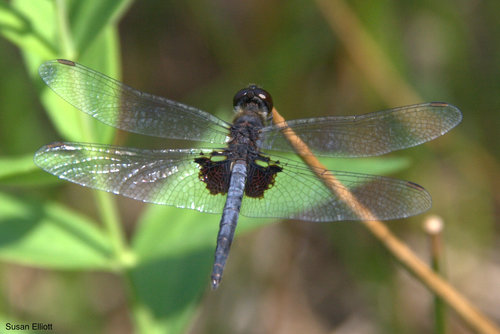
Martha's Pennant
Celithemis martha
A small but brilliant jewel of the summer wetlands, Martha’s Pennant is famous for its habit of flagging from the tallest reeds. Watch for the mature males, which transform from golden-yellow into a striking, deep crimson as they age.
Quick Identification
Size
25–33 mm (1.0–1.3 in) long with a 45–55 mm (1.8–2.2 in) wingspan
Colors
Mature males are deep crimson or maroon-black; females and juveniles are golden-yellow with black abdominal spots. Both have clear wings with dark patches at the base and center.
Key Features
- Distinctive dark patches at the base and midpoint of each wing
- Deep red to brownish-black body in mature males
- Habit of perching on the very tips of tall vegetation
- Small, slender skimmer profile
When You’ll See Them
Behavior
Martha's Pennant is a classic 'percher,' so named for its habit of resting on the very tips of reeds, twigs, or tall grasses. From these vantage points, they sway in the wind like small flags or pennants, scanning the environment for both potential prey and rivals. Unlike larger dragonflies that spend hours on the wing patrolling a territory, this species prefers to hunt in short, explosive bursts, darting out to snatch a flying insect and returning almost immediately to the same or a nearby perch.
Socially, they are quite competitive. Males will aggressively defend their favorite perching spots, often spiraling upward in 'dogfights' with other males to establish dominance over a prime hunting or mating location. They are highly sun-dependent; during the hottest parts of the day, you may observe them 'obelisking'—pointing their tails directly at the sun to reduce the surface area exposed to heat, a fascinating example of insect thermoregulation.
EverydayEarth exclusive
Camera Tips
To capture Martha's Pennant on camera, you must think like a percher. These dragonflies are creatures of habit and will return to the same tall reed or twig repeatedly. Position your camera on a tripod at a height of about 3 feet, aiming it at the tallest piece of vegetation near a pond's edge. Using a macro lens or a high-quality zoom is vital, as this is one of the smaller pennant species and requires close-up detail to distinguish it from its cousins. A fast shutter speed of at least 1/1000s is recommended to freeze the movement of their wings.
If your backyard doesn't have natural reeds, you can 'engineer' a photo opportunity by placing several 3-foot bamboo garden stakes near the water. Angle your camera so that the background is as distant as possible; this creates a beautiful 'bokeh' effect that makes the crimson body of the male Martha's Pennant pop against a soft, green backdrop. Because they are most active in direct sunlight, mid-day is actually the best time for filming, though you should be mindful of harsh shadows. Try to position the camera with the sun at your back to illuminate the intricate wing veins.
For AI-powered cameras, set your motion detection zone to the top 20% of your perching stake. This prevents the camera from triggering every time a ripple moves the water or a low-lying leaf blows in the wind. Since these insects are cold-blooded, they won't show up on thermal sensors, so rely on optical motion detection. If you're looking for the best seasonal window, late July is the 'sweet spot' when populations are at their densest and the males have reached their most brilliant deep-red coloration.
Similar Species
Species that look similar or are commonly confused with Martha's Pennant.
Halloween Pennant
Much larger with more extensive orange and black banding across the entire wing.
Double-ringed Pennant
Lacks the vibrant red of the male Martha's and has different black markings on the abdomen.
Calico Pennant
Has heart-shaped spots on the abdomen and more extensive red markings on the wings.
Frequently Asked Questions
Record Martha's Pennant at your habitat
Connect a camera to start building your own species record — AI identifies every visitor automatically.