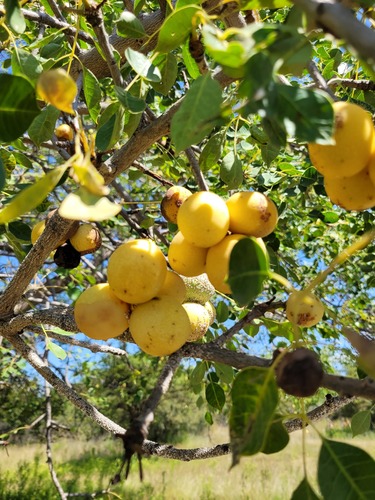
marula
Sclerocarya birrea
The Marula is the undisputed 'Tree of Life' of the African savanna, a massive provider that feeds everyone from elephants to local communities. With its iconic mottled bark and vitamin-rich yellow fruit, it is a centerpiece of biodiversity and a magnet for backyard wildlife photography.
Quick Identification
Size
Typically 9–18 m (30–60 ft) tall with a canopy spread of up to 20 m (65 ft).
Colors
Mottled grey bark with patches of pale yellow or brown; bright green leaves; butter-yellow fruit when ripe.
Key Features
- Distinctive mottled bark that peels in circular discs
- Broad, rounded and spreading green canopy
- Plum-sized fruit that turns yellow and drops when ripe
- Pinnate leaves with 7–13 paired leaflets
- Dioecious, meaning trees are either male or female
When You’ll See Them
Behavior
The Marula is a resilient and generous deciduous tree, acting as a vital life-support system for the African savanna. It survives harsh dry seasons by dropping its leaves, standing as a skeletal figure until the first rains signal a rapid transformation into a lush, green umbrella. Because it is dioecious, only the female trees produce the famous fruit, which drop to the ground while still green and ripen into a fragrant, yellow bounty that can be smelled from a distance.
While legends often tell of 'drunken elephants' eating fermented Marula fruit, in reality, the fruit is a critical source of hydration and Vitamin C for a wide variety of species. Beyond its fruit, the tree is socially significant; its wide canopy creates a natural meeting place or 'kgotla' for human communities, providing deep shade in the heat of the day. Its interaction with wildlife is symbiotic, as many animals help disperse its large, hard-shelled seeds across the landscape.
EverydayEarth exclusive
Camera Tips
To capture the incredible biodiversity that a Marula attracts, you should focus your camera efforts on a female tree during the peak fruiting months of mid-to-late summer. Look for a tree with a high concentration of fallen fruit on the ground. Position your camera about 15 to 20 feet away from the trunk, mounted on a sturdy post or a neighboring tree. Because heavy hitters like elephants and giraffes are frequent visitors, it is essential to use a reinforced security housing or 'bear box' to prevent your camera from being investigated too roughly or stepped on.
For the best results, set your camera to a hybrid mode that captures both a high-resolution still and a 20-second video clip. The fruit attracts a massive variety of animals, from baboons and monkeys during the day to porcupines, honey badgers, and bushpigs at night. High-intensity infrared (IR) flash is a must for those nocturnal visitors, as the dense canopy can make the area under the tree quite dark even under moonlight. If your camera allows, set a 'quiet period' of about 2-3 minutes between triggers to avoid thousands of videos of a single elephant herd foraging.
Consider a long-term time-lapse project for the Marula. By taking one photo every day at noon from the same spot, you can document the tree’s dramatic seasonal cycle—from the first flush of green buds to the heavy fruiting stage and the eventual leaf drop in winter. This provides a stunning visual narrative of the savanna's pulse. Ensure your lens is angled slightly downward to capture the action on the ground where the fruit lies, as this is the primary stage for animal interactions.
Similar Species
Species that look similar or are commonly confused with marula.
Frequently Asked Questions
Record marula at your habitat
Connect a camera to start building your own species record — AI identifies every visitor automatically.