Melon Aphid
Aphis gossypii
The Melon Aphid is a tiny titan of the garden, capable of building massive colonies through the power of cloning. Discover how these sap-suckers interact with 'rancher' ants and survive in a world of much larger predators.
Quick Identification
Size
1.0 to 1.5 mm (0.04 to 0.06 inches) in length
Colors
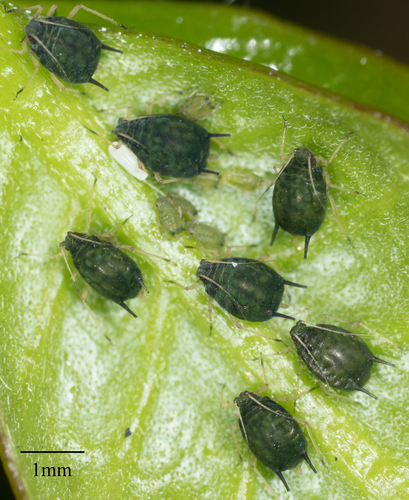
Highly variable; ranges from pale yellow and light green to dark mottled green or almost black. Regardless of body color, the siphunculi (tail-pipes) are always black.
Key Features
- Pair of prominent black siphunculi (tail-pipes) at the rear
- Pear-shaped, soft body
- Antennae shorter than the length of the body
- Often found in dense clusters on leaf undersides
When You’ll See Them
Behavior
Melon Aphids are masters of rapid colonization. During the spring and summer, these insects reproduce through parthenogenesis, meaning females give birth to live, pregnant clones of themselves without the need for mating. This allows a solitary aphid to transform into a massive colony in a matter of days, quickly coating the stems and leaves of a host plant.
One of their most intriguing behaviors is their symbiotic relationship with ants. As Melon Aphids consume vast amounts of plant sap, they excrete a sticky, sugary liquid known as honeydew. Ants prize this honeydew as a food source and will actively 'farm' the aphids, protecting them from predators like ladybugs and even moving them to healthier parts of the plant to ensure a steady supply of sugar.
EverydayEarth exclusive
Camera Tips
Because Melon Aphids are incredibly small, capturing them on camera requires a dedicated macro lens or a camera capable of extreme close-up focus. Your best bet is to mount your camera on a stable tripod and position it just a few inches away from the underside of a leaf on a known host plant, such as a cucumber or a hibiscus. Use a high f-stop (small aperture) if possible to increase the depth of field, as the aphids' rounded bodies can easily fall out of focus at such close range.
Since aphids are often found in the shade of foliage, additional lighting is almost always necessary for a clear shot. Use a small, portable LED panel or a reflector to bounce natural light onto the underside of the leaf. This will highlight the translucent texture of their bodies and make the dark siphunculi pop against their green or yellow skin. If your camera has a 'time-lapse' feature, this is the perfect species for it; a time-lapse can reveal the subtle 'shimmer' of the colony moving and the constant frantic activity of the ants that tend to them.
To capture the most dramatic footage, look for 'action' indicators. If you see ladybugs, lacewing larvae, or hoverflies nearby, keep your camera running. These are the primary predators of Melon Aphids, and you may capture a rare macro-glimpse of a garden predator in the middle of a hunt. To keep the leaf steady in the wind, you can use a small 'Plamp' or a garden stake and a soft clip to anchor the stem, ensuring your tiny subjects stay perfectly centered in the frame.
Similar Species
Species that look similar or are commonly confused with Melon Aphid.
Green Peach Aphid
Green Peach Aphids have siphunculi that match their body color or are only dark at the tips, whereas Melon Aphids have entirely black siphunculi.
Oleander Aphid
Oleander Aphids are almost always a bright, saturated yellow and are found specifically on milkweed and oleander, rather than melons or hibiscus.
Frequently Asked Questions
Record Melon Aphid at your habitat
Connect a camera to start building your own species record — AI identifies every visitor automatically.