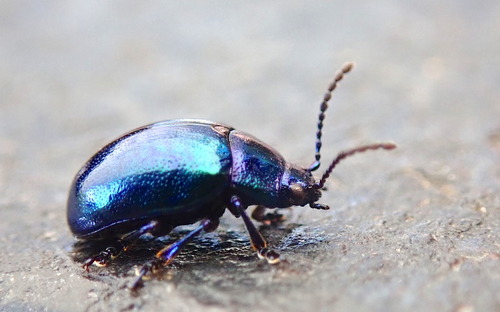
Mint beetle
Chrysolina coerulans
The Mint beetle is a living jewel of the garden, boasting a shimmering cobalt armor that stands out against the green of your herb patch. A favorite for macro-photography enthusiasts, these docile beetles turn a common mint plant into a stage for a miniature light show.
Quick Identification
Size
6–10 mm (0.23–0.4 inches) in length
Colors
Brilliant iridescent metallic blue, cobalt, or deep violet; uniform coloring across the elytra (wing covers) and thorax with a high-gloss finish.
Key Features
- Striking metallic blue or violet iridescent sheen
- Oval-shaped, convex body with visible pits or punctures on the wing covers
- Typically found on or near aromatic herbs like mint
- Slow-moving, docile behavior on foliage
When You’ll See Them
Behavior
The Mint beetle is a slow-paced herbivore that spends its adult life almost entirely on the host plants it feeds upon. They are most frequently observed basking on the upper surfaces of mint leaves during sunny days, where their metallic armor acts as a visual warning to predators. When threatened, they don't usually fly away immediately; instead, they may tuck their legs in and drop into the dense foliage below to hide in the shadows.
These beetles are social in a loose sense, often congregating in small groups on a single patch of mint. While they are considered a minor pest by some gardeners due to the small, circular holes they chew in leaves, they are generally tolerated for their aesthetic beauty. In the late summer, they lay eggs on the undersides of leaves, and the resulting larvae—which are plump and greyish—will feed alongside the adults before pupating in the soil.
EverydayEarth exclusive
Camera Tips
Capturing the Mint beetle on camera requires a specialized approach because of their small size and highly reflective surface. A standard trail camera set to a wide-angle view will likely miss them; instead, you need a camera with a macro lens or a 'close-focus' setting. Position your camera just 6 to 12 inches away from a healthy patch of mint. Because these beetles love the sun, choose a patch that receives direct morning or midday light to make their metallic blue shells truly pop on film.
To get the best video or photo triggers, use a high-sensitivity setting if your AI camera allows it, as their slow movement might not always trip a standard PIR sensor. It is often better to use a time-lapse mode, taking a photo every 1 to 5 minutes during the peak afternoon hours. This ensures you catch them as they move from the underside of the leaves to the tops to bask in the sun.
Be mindful of the 'glare' factor. The Mint beetle’s shell is like a mirror, which can cause 'hot spots' or blown-out highlights in your photos. If possible, position your camera so the sun is at a 45-degree angle to the plant rather than directly behind the camera. This creates a side-lighting effect that highlights the texture of their pitted elytra and the depth of their blue coloration without washing out the image.
Similar Species
Species that look similar or are commonly confused with Mint beetle.
Frequently Asked Questions
Record Mint beetle at your habitat
Connect a camera to start building your own species record — AI identifies every visitor automatically.