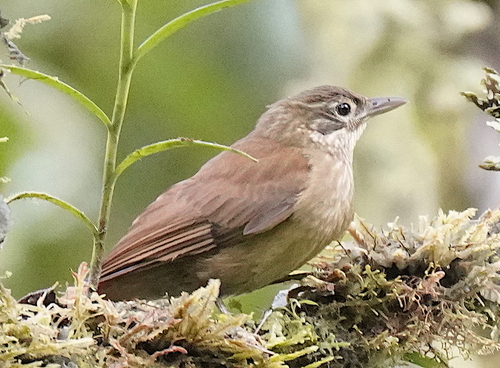
Montane Foliage-gleaner
Anabacerthia striaticollis
A master of the Andean cloud forest, the Montane Foliage-gleaner is an acrobatic insect-hunter that brings life to the misty mountain canopy. Watch as it hangs upside down to investigate hidden treasures tucked away in the moss and leaves.
Quick Identification
Size
Length: 15.5-17 cm (6-6.7 in); Weight: 20-30 g (0.7-1.1 oz)
Colors
Olive-brown upperparts, buff-colored throat with fine dark streaking, cinnamon-rufous tail, and a distinct pale buffy eye-ring and stripe behind the eye.
Key Features
- Distinctive buffy-streaked throat and neck
- Pale buffy eye-ring and post-ocular stripe
- Bright cinnamon-rufous tail and wing highlights
- Highly acrobatic foraging style, often hanging upside down
When You’ll See Them
Geographic range
Where Does the Montane Foliage-gleaner Live?
This bird is a quintessential inhabitant of the South American Andes. Its native range forms a long, narrow ribbon following the mountain chain from northern Venezuela and through all three cordilleras of Colombia. It continues southward through the humid eastern slopes of the Andes in Ecuador and Peru, reaching its southern limit in the yungas of Bolivia. It is a true montane specialist, rarely descending into the lowland basins.
Basemap © OpenStreetMap contributors
Behavior
The Montane Foliage-gleaner is a tireless and acrobatic member of the ovenbird family. It is most frequently encountered as a core member of mixed-species foraging flocks, moving through the middle and upper layers of the forest canopy. Unlike many birds that wait for insects to fly by, this species is an active hunter that meticulously investigates every nook and cranny of the forest, using its sharp beak to pry into curled dead leaves and mossy crevices.
These birds are known for their physical agility; it is common to see them hanging completely upside down from a branch to reach the underside of an epiphyte. While they are not particularly shy around humans, they are constantly on the move, making them a challenge to spot without a pair of binoculars. Their social nature means they rarely travel alone, often following woodcreepers and tanagers through the humid cloud forests.
EverydayEarth exclusive
Camera Tips
To capture a Montane Foliage-gleaner on camera, you must focus on the mid-story of the forest rather than the ground. These birds rarely descend to the forest floor, preferring to stay between 5 and 15 meters high. Look for areas with a high density of epiphytes, moss-covered branches, or clusters of trapped dead leaves. Mounting your camera on a platform or a sturdy limb overlooking a dense 'tangle' of vegetation is your best bet for a clear shot.
Because these birds are extremely fast and jittery, your camera's trigger speed is critical. Set your device to its fastest possible trigger mode and use 'burst' or 'multi-shot' settings. They often pause for just a fraction of a second to inspect a leaf before moving on, so a slow camera will likely only capture a blurred tail or an empty branch. High-resolution video can also be effective, as it allows you to extract still frames of their acrobatic poses.
While they don't visit traditional bird feeders, you can attract them to a camera site by providing a high-quality water source, such as a dripping mister or an elevated birdbath placed near cover. In a backyard setting within their elevation range, planting native trees that host local insect populations and leaving some leaf litter trapped in the lower branches of shrubs will encourage them to stick around and forage in view of your lens.
Similar Species
Species that look similar or are commonly confused with Montane Foliage-gleaner.
Buff-fronted Foliage-gleaner
Lacks the distinct throat streaking of the Montane and has a more prominent buffy patch on the forehead.
Streaked Tuftedcheek
Much more heavily streaked overall with prominent pale 'tufts' on the cheeks and a larger body size.
Lineated Foliage-gleaner
Found at lower elevations and features much more prominent, bold white streaks across the back and underparts.
Frequently Asked Questions
Record Montane Foliage-gleaner at your habitat
Connect a camera to start building your own species record — AI identifies every visitor automatically.