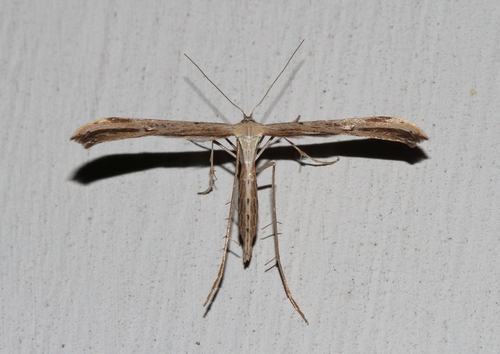
Morning-glory Plume Moth
Emmelina monodactyla
A master of disguise that looks more like a floating twig than a moth, the Morning-glory Plume Moth is a fascinating frequent visitor to backyard gardens across the globe.
Quick Identification
Size
Wingspan of 18–27 mm (0.7–1.1 in) and a body length of approximately 12-15 mm
Colors
Pale buff, light brown, or greyish-white with small black dots along the wing margins
Key Features
- Distinctive T-shaped profile at rest
- Wings rolled into tight cylinders perpendicular to the body
- Long, spindly legs with prominent tibial spurs
- Deeply cleft hindwings (plumes) visible only in flight
- Pale, almost translucent brown coloration
When You’ll See Them
Geographic range
Where Does the Morning-glory Plume Moth Live?
The Morning-glory Plume Moth is a highly successful generalist with a massive global footprint. It is native to and widespread across Europe, North Africa, and Central Asia, while also being one of the most common plume moths found throughout North America, from southern Canada to Mexico. Because it thrives in disturbed habitats where its favorite host plants—the morning glory and bindweed—are abundant, it is a staple of suburban and urban ecology throughout the Northern Hemisphere.
Basemap © OpenStreetMap contributors
Behavior
The Morning-glory Plume Moth is a master of mimicry, often mistaken for a dried blade of grass or a small twig. Its most striking behavior is its resting posture; unlike most moths that fold their wings flat or in a roof-like shape, this species rolls its forewings into tight tubes and holds them straight out from its sides. This unique 'T' shape breaks up its silhouette, making it nearly invisible to predators while it rests on garden fences or plant stems during the day.
Primarily nocturnal, these moths emerge at dusk to feed and find mates. They are highly attracted to artificial lights, which is why they are so frequently spotted on window screens and porch lights. Interestingly, this species is one of the few moths that hibernates as an adult. They seek out sheltered spots in ivy, outbuildings, or thick vegetation to survive the winter, occasionally emerging on unseasonably warm nights to stretch their wings.
EverydayEarth exclusive
Camera Tips
To capture high-quality footage of the Morning-glory Plume Moth, focus your camera on its primary host plants: Morning Glories or the common garden weed, Bindweed. Position your camera about 12-18 inches from the vines, ideally using a macro lens or a camera with a short focal distance. Since these moths are active after dark, ensure your camera’s infrared (IR) night vision is enabled, or place a low-intensity UV light nearby to attract them into the frame for a closer look.
Placement is key for these structural mimics. They love to rest on vertical surfaces like fence posts, light-colored siding, or garden stakes near their food sources. Try mounting your camera at chest height facing a flat, neutral-colored surface where the moth's unique T-shaped silhouette will stand out. If you are using a trigger-based camera, set the motion sensitivity to high; their flight is incredibly light and airy, and they may not always trigger sensors designed for larger mammals.
During the winter months, don't pack your gear away. Look for them in sheltered spots like the undersides of evergreen leaves, inside garden sheds, or tucked into thick ivy. A camera placed near these overwintering sites can catch them as they emerge on warmer evenings. For the best identification shots, try to get a direct top-down view to showcase the 'cross' shape, or a side-on profile to capture their long, spindly legs and the spurs on their hind legs.
Similar Species
Species that look similar or are commonly confused with Morning-glory Plume Moth.
Frequently Asked Questions
Record Morning-glory Plume Moth at your habitat
Connect a camera to start building your own species record — AI identifies every visitor automatically.