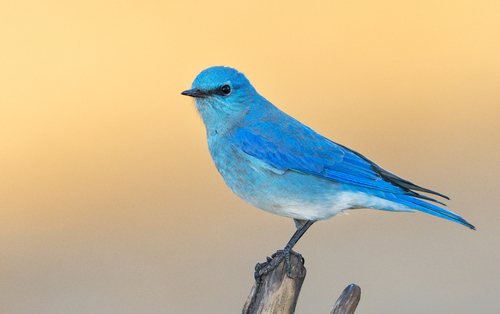
Mountain Bluebird
Sialia currucoides
The Mountain Bluebird is a vibrant splash of sky fallen to earth. This hardy mountain traveler is beloved for its brilliant turquoise feathers and its unique ability to hunt while hovering in mid-air.
Quick Identification
Size
Length: 16–20 cm (6.3–7.9 in); Wingspan: 28–36 cm (11–14 in); Weight: 27–33 g (0.95–1.16 oz)
Colors
Adult males are a brilliant, uniform cerulean or turquoise blue, paler on the belly. Females are mostly soft gray with blue highlights on wings and tail, and a white lower belly.
Key Features
- Brilliant turquoise-blue plumage on males
- Thin, straight bill for insect eating
- Unique hovering or 'kiting' flight while hunting
- Lack of rufous/orange on the breast compared to other bluebirds
When You’ll See Them
Geographic range
Where Does the Mountain Bluebird Live?
Native to the mountainous regions of Western North America, the Mountain Bluebird thrives from the subarctic tundra of Alaska and the Yukon down through the western United States. Their core range extends through the Rocky Mountains and Great Basin, stretching as far east as the western Dakotas and Oklahoma during the breeding season. In the winter months, these migratory birds move to the southwestern United States and central Mexico, seeking out lower elevations and warmer climates where food remains plentiful.
Basemap © OpenStreetMap contributors
Behavior
Mountain Bluebirds are charismatic and social thrushes, well-known for their graceful hunting style. Unlike their eastern and western cousins, they frequently hunt by hovering in mid-air over open fields, a behavior known as 'kiting,' before pouncing on insects in the grass. They are cavity nesters that readily take to man-made nest boxes, making them a common sight in rural and suburban areas where appropriate housing is provided.
During the breeding season, males are highly territorial and can be seen perched prominently on fence posts or low branches, singing a warbling song to defend their space. In the winter, their social structure shifts significantly; they gather in large, nomadic flocks that roam through juniper forests and lower-elevation scrublands in search of berries. Their interaction with humans is generally peaceful, and they are considered a welcome sign of spring across the western mountains.
EverydayEarth exclusive
Camera Tips
To capture the breathtaking turquoise of a Mountain Bluebird on your backyard camera, placement is everything. These birds prefer open vistas and wide-of-sight views, so position your AI-powered camera near a nesting box or a favorite hunting perch like a fence post or a T-post. Setting the camera at a height of 4 to 5 feet, angled slightly upward toward the perch, will help you capture both their vibrant underbelly and their distinctive hovering flight maneuvers.
Since Mountain Bluebirds are primarily insect-eaters, a standard birdseed mix won't lure them in. Instead, use a shallow dish of live or dried mealworms placed within 3 to 6 feet of the camera lens. During the spring nesting season, you can also attract them with a birdbath; the splashing movement often triggers the motion sensors on trail cameras, providing excellent footage of their social behavior and preening.
Lighting is the 'secret sauce' for bluebird photography. Because their blue color is structural (caused by light scattering rather than pigment), they look most vibrant in direct sunlight. Place your camera facing north or south to avoid harsh backlighting, ensuring the sun illuminates the bird's chest and wings. Early morning hours are the most productive, as these birds are most active in the first few hours after sunrise when they are hungriest and the light is softest.
Similar Species
Species that look similar or are commonly confused with Mountain Bluebird.
Western Bluebird
Western Bluebirds have a bright orange-red breast and throat, whereas Mountain Bluebirds are solid turquoise-blue on their front.
Eastern Bluebird
Eastern Bluebirds feature a warm reddish-brown throat and breast and are typically found further east, though ranges occasionally overlap in the plains.
Frequently Asked Questions
Record Mountain Bluebird at your habitat
Connect a camera to start building your own species record — AI identifies every visitor automatically.