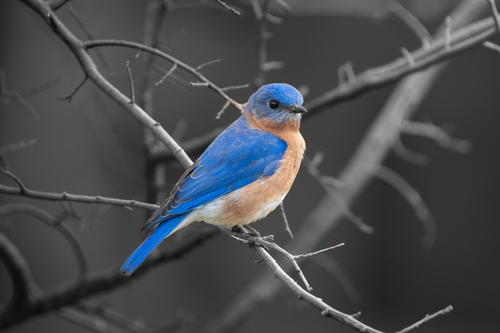
Eastern Bluebird
Sialia sialis
A flash of brilliant azure in the garden, the Eastern Bluebird is a symbol of spring and one of North America's most beloved backyard visitors.
Quick Identification
Size
Length: 16–21 cm (6.3–8.3 in); Wingspan: 25–32 cm (9.8–12.6 in); Weight: 27–34 g (0.95–1.2 oz)
Colors
Males feature a brilliant royal blue back and head with a warm reddish-orange chest and white belly. Females are more subdued, with grayish-blue upperparts and a paler peachy-orange breast.
Key Features
- Vibrant blue upperparts and head
- Bright rusty-red throat and breast
- Pure white lower belly and undertail
- Round-headed, stocky thrush silhouette
- Large dark eyes
When You’ll See Them
Geographic range
Where Does the Eastern Bluebird Live?
Native to the North American continent, the Eastern Bluebird occupies a vast territory stretching from southeastern Canada through the entire eastern half of the United States. They are core residents throughout the American South and Midwest, with their range extending southwards through the highlands of Mexico and into parts of Central America like Honduras and Nicaragua. While northern populations may move south in winter, they are a beloved year-round fixture in most temperate parts of their range.
Basemap © OpenStreetMap contributors
Behavior
Eastern Bluebirds are charismatic songbirds known for their 'perch and pounce' hunting style. You will often see them sitting upright on a fence post or low branch, scanning the ground for movement before fluttering down to snatch an insect. They are social birds, especially outside of the breeding season, when they may gather in small flocks to forage for berries or huddle together in cavities to stay warm during winter nights.
While they are naturally cavity nesters, they have developed a close relationship with humans through the use of birdhouses. They are generally peaceful and welcome visitors to suburban yards, though they can become quite territorial against other bluebirds or competing species like Tree Swallows during the nesting season. Their song is a series of soft, melodious warbles that many birdwatchers find to be one of the most pleasant sounds of spring.
EverydayEarth exclusive
Camera Tips
To capture stunning footage of Eastern Bluebirds, the most reliable strategy is to focus your AI camera on a dedicated bluebird nest box or a mealworm feeder. Since bluebirds are cavity nesters, mounting a camera roughly 12-18 inches away from the entrance hole of a birdhouse (using a side-mount or specialized bracket) provides a front-row seat to nesting behaviors, though you should ensure the camera doesn't obstruct the birds' flight path. Set the camera at a height of 4 to 6 feet to match their typical nesting and perching level.
Bluebirds are highly attracted to moving water, so a birdbath with a 'wiggler' or fountain is an excellent secondary location for your camera. If you are using a trail camera in an open field, look for a lone fence post or a low-hanging branch near short grass—these are favorite hunting perches. Use a high shutter speed or 'burst mode' if available, as their 'pounce' on insects is lightning-fast and can result in motion blur on slower settings.
Regarding bait, Eastern Bluebirds are suckers for live or dried mealworms. Placing a small tray of mealworms within the camera's focal range will almost guarantee a visit. During the winter, you can attract them with suet crumbles or softened raisins. For the best lighting, try to position your camera facing north or south to avoid the harsh glare of the rising or setting sun, which can wash out the brilliant blue of the male's plumage.
Similar Species
Species that look similar or are commonly confused with Eastern Bluebird.
Western Bluebird
Western Bluebirds have a blue throat and more chestnut color on their backs compared to the Eastern's red throat.
Mountain Bluebird
Mountain Bluebirds are almost entirely sky-blue with a white belly, lacking the rusty-red breast of the Eastern Bluebird.
American Robin
Robins also have orange breasts but are much larger, have dark gray backs, and lack the brilliant blue plumage.
Frequently Asked Questions
Record Eastern Bluebird at your habitat
Connect a camera to start building your own species record — AI identifies every visitor automatically.