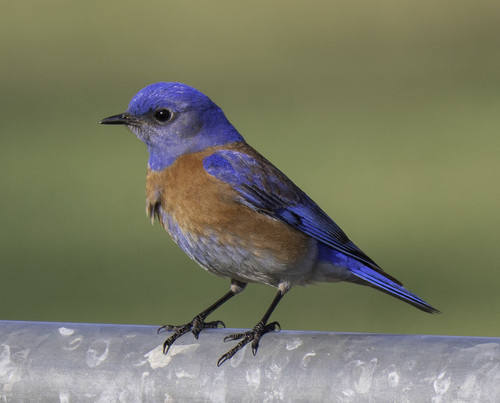
Western Bluebird
Sialia mexicana
A flash of cobalt blue against a rusty breast marks the arrival of the Western Bluebird, one of the most beloved backyard visitors in the West.
Quick Identification
Size
Length: 15-18 cm (6-7 in); Wingspan: 29-33 cm (11-13 in); Weight: 24-31 g (0.8-1.1 oz)
Colors
Males have brilliant cobalt blue heads, wings, and tails with a rusty-red breast and crescent on the back. Females are duller, with grayish-brown bodies and subtle blue tints in the wings.
Key Features
- Blue throat (males)
- Rusty-orange breast and upper back patches
- Stocky thrush silhouette
- Straight, slender black bill
When You’ll See Them
Sightings on EverydayEarth
Jun 14, 2026
A California Condor is seen at extremely close range in the foreground, moving its head and preening its feathers. A Western Bluebird briefly flies through the middle ground from left to right. Toward the end of the clip, the condor begins to spread its wings, showing its impressive size and the white feathers on the underside of its wings.
Mar 31, 2026
A Western Bluebird is foraging on the ground in a patch of dirt in the foreground. In the background, two Common Ravens land on the roof of a small building, perching briefly as they survey the area.
Behavior
Western Bluebirds are social and relatively gentle songbirds often seen perching on low branches, fence posts, or signs while scanning the ground for movement. They are "drop-hunters," a foraging style where they sit motionless and then suddenly dive onto an insect in the grass. While territorial during the nesting season, they frequently form small family flocks during the winter to forage for berries together.
These birds are secondary cavity nesters, meaning they rely on old woodpecker holes or man-made birdhouses rather than drumming out their own homes. In backyard settings, they are remarkably tolerant of humans and can become quite accustomed to a regular feeding schedule, often waiting nearby when they see their favorite treats being offered.
EverydayEarth exclusive
Camera Tips
To capture the best footage of Western Bluebirds, focus your camera efforts on three key areas: the nest box, the watering station, and the mealworm feeder. If you have a nest box installed, mount your camera 5 to 10 feet away at a 45-degree angle to the entrance. This positioning captures the spectacular flight shots as the parents bring food to the chicks. Using a high shutter speed or a 'sports mode' on your AI camera is essential, as their wing beats are incredibly fast.
Moving water is the ultimate magnet for this species. Western Bluebirds are frequent bathers and are highly attracted to the sound of a solar-powered dripper or a small fountain. Position your camera at bird-eye level (about 2-3 feet off the ground) at the edge of the birdbath. Use a 'Photo + Video' setting if available; the bluebirds often engage in social 'wing-shivering' and splashing that looks better in motion, while the photos will capture the stunning detail of their blue plumage.
For feeding stations, Western Bluebirds are most likely to visit if you offer live or dried mealworms in a shallow, open dish. To avoid 'ghosting' or blurry images, ensure the feeder is in a well-lit area but out of direct afternoon sun, which can wash out the deep cobalt blues of the male. Set your camera's PIR (motion) sensitivity to high, as these birds are lightweight and may not trigger lower-sensitivity settings. In the winter, moving your camera to face berry-producing shrubs like Toyon or Elderberry can yield beautiful 'wild' shots of them foraging.
Finally, consider the background. Because the male's blue is so vibrant, placing a neutral-colored perch (like an old weathered branch) in front of your camera will help the bird's colors pop. If you are using a trail camera, a 0.5-second trigger speed or faster is recommended to catch them as they land, as they often spend only a few seconds at the feeder before flying back to a safe lookout perch.
Similar Species
Species that look similar or are commonly confused with Western Bluebird.
Frequently Asked Questions
Record Western Bluebird at your habitat
Connect a camera to start building your own species record — AI identifies every visitor automatically.