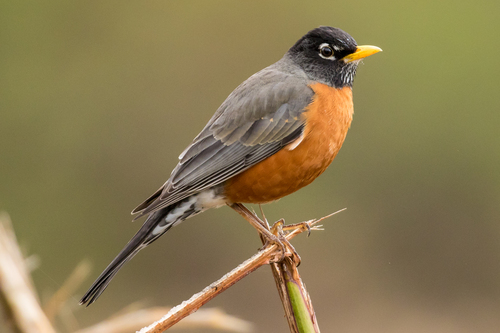
American Robin
Turdus migratorius
Often called the harbinger of spring, the American Robin is a friendly, red-breasted neighbor found in backyards across the continent. Watch them hunt for worms and listen for their iconic, cheery song at the break of dawn.
Quick Identification
Size
Length: 23-28 cm (9-11 in); Wingspan: 31-41 cm (12-16 in); Weight: 77 g (2.7 oz)
Colors
Dark gray-brown back and wings, rich brick-red or orange breast, white throat with black streaks, and a white eye ring. Males are generally darker on the head and more vibrant than females.
Key Features
- Bright orange-red breast
- White broken eye ring
- Yellow bill with a dark tip
- Long tail and upright posture
When You’ll See Them
Sightings on EverydayEarth
Apr 28, 2026
A male Red-bellied Woodpecker lands on the feeder tray and begins searching through the seeds, looking around alertly. In the background, an American Robin perches briefly on a nearby feeder hook before flying off.
Mar 3, 2026
Various bird species visit the feeder tray in quick succession to forage. Initially, a male House Finch and an American Tree Sparrow are present. They are later replaced by a pair of House Sparrows (male and female). The sequence ends with an American Robin landing abruptly on the rim of the tray, filling the camera's view.
Apr 1, 2026
An American Robin lands on the edge of the copper bird bath, perching momentarily to survey the backyard before moving closer to the camera lens.
Jul 25, 2026
A Common Grackle is perched on the edge of the feeder tray in the foreground, looking around and pecking at seeds. An American Robin arrives, landing on a tube feeder to the right before hopping down to the tray alongside the grackle.
Jul 24, 2026
A juvenile American Robin sits in the center of the feeder tray, exhibiting its characteristic speckled breast. A male Red-winged Blackbird lands on the right side of the tray shortly after, displaying its bright red and yellow shoulder patches while searching for seeds. A Common Grackle is also visible perched on top of the central feeder pole before flying off.
Jul 6, 2026
An American Robin is perched on a black floating barrier in the water. The bird remains alert, turning its head several times to scan the surroundings while maintaining its position on the structure.
Geographic range
Where Does the American Robin Live?
Native to the North American continent, the American Robin boasts an incredibly wide distribution that spans from the tree line of northern Alaska and Canada down through the heart of the United States and into the highlands of central Mexico. These adaptable birds are common sights across almost every state and province, thriving in diverse environments from suburban lawns to remote mountain forests. While many populations migrate south for the winter, others remain as year-round residents in the central and southern United States wherever food remains abundant.
Basemap © OpenStreetMap contributors
Recorded on EverydayEarth
Behavior
The American Robin is a social and highly visible bird, often seen hopping across lawns in search of earthworms. They are famous for their 'running and stopping' foraging technique, where they tilt their heads to the side—not to listen, but to get a better visual on movement beneath the soil. While they are territorial during the spring breeding season, they become incredibly social in the winter, forming massive communal roosts that can include hundreds or even thousands of birds.
These birds are among the first to sing in the morning, often starting their 'dawn chorus' before the sun even rises. Their song is a cheery, rising-and-falling warble that most people associate with the arrival of spring. Though they are comfortable around humans and frequently nest on porch ledges or in backyard trees, they remain alert and will give a sharp 'peek' or 'tut' alarm call if a predator like a cat or hawk is nearby.
EverydayEarth exclusive
Camera Tips
To capture the best footage of American Robins, place your camera near ground level. Since these birds spend the majority of their time foraging for worms in the grass, a camera mounted 6 to 12 inches off the ground, angled slightly downward toward a patch of open lawn, will yield much more intimate shots than a high-mounted unit. Look for areas where the grass is kept short, as this is where they prefer to hunt.
Water is the ultimate lure for a Robin. Unlike many other backyard birds that might visit a seed feeder, Robins are primarily attracted to birdbaths and shallow water features. Position your camera facing a birdbath or a flat stone in a pond. To get clear action shots of them splashing, ensure your camera has a fast shutter speed or 'burst mode' enabled to minimize motion blur during their vigorous bathing sessions.
Timing is everything with this species. They are most active during the 'blue hour' just before sunrise and again in the late afternoon. If your AI camera allows for scheduling, prioritize these windows. In the winter months, if you want to keep them on camera, consider a heated birdbath or planting berry-producing shrubs like Winterberry or Serviceberry nearby, as these will become their primary focal points when the ground freezes and worms are unavailable.
Similar Species
Species that look similar or are commonly confused with American Robin.
Varied Thrush
Similar orange breast, but features a thick black 'necklace' band across the chest and orange wing bars.
Orchard Oriole
Much smaller and thinner with a pointed beak; males have a deep chestnut belly rather than the Robin's bright orange.
Eastern Bluebird
Has an orange breast but is significantly smaller with bright blue upperparts and wings.
Frequently Asked Questions
Record American Robin at your habitat
Connect a camera to start building your own species record — AI identifies every visitor automatically.