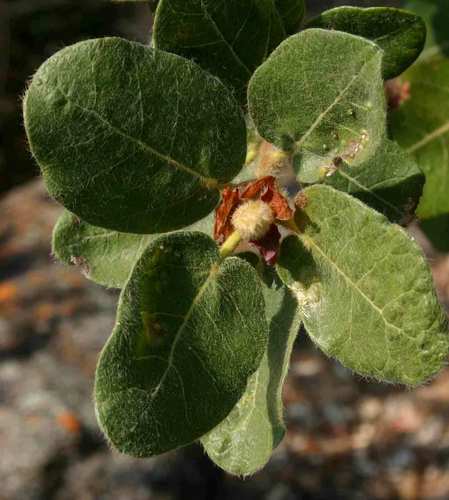
Mountain rock fig
Ficus glumosa
A true architect of the cliffs, the Mountain rock fig turns barren stone into a thriving vertical garden. With its velvet-soft leaves and bounty of sweet fruit, it serves as the ultimate magnet for Africa's most colorful birds and elusive climbers.
Quick Identification
Size
A robust tree reaching heights of up to 20 m (65 ft), with a canopy spread often exceeding its height in open terrain.
Colors
Smooth, pale grey to yellowish bark; dark green leaves with prominent yellow veins; figs ripen from green to a vivid orange-red or purplish-red.
Key Features
- Large, leathery leaves with distinctly hairy (pubescent) undersides
- Small, round figs (8-15mm) usually found in pairs in the leaf axils
- Aggressive, pale root system that often clings to or splits rocks
- Smooth, light-colored bark that contrasts with dark foliage
When You’ll See Them
Behavior
The Mountain rock fig is a tenacious survivor of the Afrotropical landscape, known for its ability to colonize seemingly inhospitable rocky outcrops, or 'kopjes.' Unlike many other trees, it doesn't just grow on the earth; it wraps its powerful, serpentine roots around stone, finding moisture in deep crevices and eventually helping to break down the rock itself. This growth habit makes it a literal anchor for local ecosystems.
Ecologically, this tree acts as a bustling 24-hour diner for local wildlife. It shares a fascinating symbiotic relationship with specialized fig wasps, which are the tree's only pollinators. In exchange for pollination, the tree provides a safe nursery for the wasps inside the developing fruit. For humans, these trees are often respected as providers of shade and traditional medicine in many African cultures, though their fruit is generally more favored by birds than people.
EverydayEarth exclusive
Camera Tips
Capturing the Mountain rock fig on camera is less about the tree itself and more about the incredible biodiversity it attracts. To get the best results, position your camera on a nearby rock or a sturdy branch facing a cluster of ripening figs. Because these figs are small and often tucked under leaves, a camera with a good macro or close-focus capability will reveal the fascinating world of the insects and small birds that feast here. If you are aiming for larger visitors, mount the camera 5-10 feet back from the trunk to capture monkeys or rock hyraxes climbing the bark.
Angle your camera slightly upward if you are placing it at the base of a rock face where the tree grows. This captures the 'stairway' effect of the roots which many small mammals use as a path. For lighting, the pale grey bark can reflect a lot of sunlight, potentially overexposing your shots during midday. Aim for a spot that receives dappled light or use a camera with high dynamic range (HDR) settings to balance the bright bark against the dark green leaves.
Don't stop recording when the sun goes down. Mountain rock figs are a major draw for nocturnal life. Set your camera to 'Hybrid Mode' (photo and video) with infrared flash enabled to catch fruit bats visiting the figs or owls perched in the branches. If you can safely secure a camera high in the canopy, you might even catch a leopard using the thick branches as a lookout point.
Timing is everything with this species. Monitor the figs; when they transition from green to orange or red, increase your trigger frequency and decrease the 're-arm' time on your sensors. A fruiting Ficus glumosa can see dozens of species in a single day, from turacos and barbets to baboons. Using a high-speed shutter setting (1/500 or faster) is recommended if you want to freeze the action of birds landing and taking off from the branches.
Similar Species
Species that look similar or are commonly confused with Mountain rock fig.
Wonderboom Fig
The Wonderboom (Ficus salicifolia) has much narrower, willow-like leaves and lacks the characteristic hairy undersides of the Mountain rock fig.
Common Wild Fig
Ficus thonningii has smaller, hairless leaves and a more aggressive 'strangling' growth habit compared to the rock-clinging F. glumosa.
Frequently Asked Questions
Record Mountain rock fig at your habitat
Connect a camera to start building your own species record — AI identifies every visitor automatically.