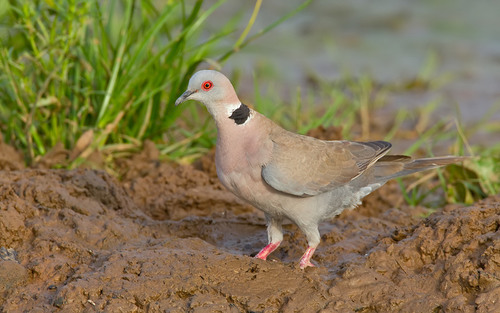
Mourning Collared Dove
Streptopelia decipiens
Not to be confused with its North American namesake, the Mourning Collared Dove is a gem of the African savanna. Known for its elegant black collar and striking red eyes, this peaceful resident is a common visitor to any backyard with a steady supply of water.
Quick Identification
Size
Length: 28-31 cm (11-12 in); Wingspan: 45-50 cm (18-20 in); Weight: 140-230 g (5-8 oz)
Colors
Pale grey forehead and crown, pinkish-grey breast and underparts, earthy grey-brown back and wings, with a bold black half-collar on the back of the neck. Deep red eyes surrounded by a bare red orbital ring.
Key Features
- Distinct black half-collar on the nape
- Prominent red orbital ring and iris
- Broad white tips on the outer tail feathers
- Pale grey forehead contrasting with a darker crown
When You’ll See Them
Geographic range
Where Does the Mourning Collared Dove Live?
The Mourning Collared Dove is native to the African continent, found extensively throughout sub-Saharan Africa. Its core range stretches from the Sahel region in the north, including Senegal and Ethiopia, down through East Africa into South Africa and Botswana. While it is a widespread resident, its presence is most concentrated in areas with reliable access to rivers, lakes, or irrigation systems, making it a common sight in well-watered suburban environments across its range.
Basemap © OpenStreetMap contributors
Behavior
The Mourning Collared Dove is a social and gentle bird, frequently observed in pairs or small, loose flocks. They are highly dependent on water and are often the first birds to arrive at watering holes in the early morning or late afternoon. Despite their somewhat melancholic common name—derived from their rhythmic, four-note cooing—they are quite active and visible, often mingling peacefully with other dove species at communal feeding or drinking sites.
In backyard settings, these doves are ground-foragers with a calm temperament. They spend much of their time walking with a characteristic rhythmic head-bob, searching for fallen seeds. While they are wary of sudden movements, they can become quite accustomed to human presence in suburban gardens and parks, making them excellent subjects for backyard observation.
EverydayEarth exclusive
Camera Tips
To capture the best footage of a Mourning Collared Dove, position your AI camera near a low-profile water feature or a ground-level bird bath. These birds are highly water-dependent and will visit a reliable water source daily, usually at predictable times in the early morning or just before dusk. Placing the camera about 12 to 18 inches off the ground at a slight downward angle will capture their intricate feather patterns and distinctive red eye rings perfectly.
Because they are ground foragers, scattering a mix of small grains or wild bird seed in a flat, open area in front of the camera is a highly effective lure. Try to choose a spot with 'dappled' sunlight; direct midday sun can wash out the subtle pink and grey tones of their plumage, while the golden hour light in the late afternoon really brings out the warm hues in their breast feathers.
Set your camera to a high frame rate if possible. Mourning Collared Doves have a very fast, jerky head motion when foraging and a sudden, clapping wing-beat when taking flight. A fast shutter speed or high-quality video mode will prevent motion blur during these rapid movements. If you are using a trigger-based system, set a short delay or high sensitivity, as they often approach feeding areas cautiously before settling in for several minutes of quiet foraging.
Similar Species
Species that look similar or are commonly confused with Mourning Collared Dove.
Red-eyed Dove
Larger and darker than the Mourning Collared Dove, with a deeper pink-grey plumage and no pale grey forehead.
Ring-necked Dove
Smaller with a dark iris (not red) and lacks the bare red skin around the eye.
African Collared Dove
Paler overall with a more creamy-buff color and lacks the red orbital ring around the eye.
Frequently Asked Questions
Record Mourning Collared Dove at your habitat
Connect a camera to start building your own species record — AI identifies every visitor automatically.