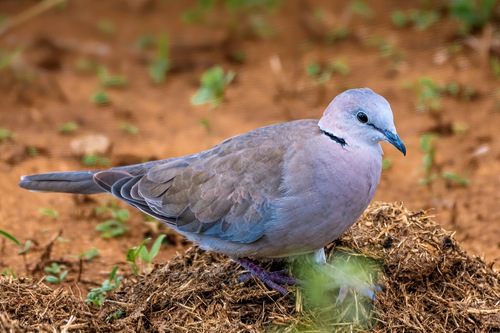
Ring-necked Dove
Streptopelia capicola
With its rhythmic 'work-harder' call and gentle demeanor, the Ring-necked Dove is a quintessential sight and sound of the African landscape. This adaptable bird brings a sense of peaceful activity to any backyard it visits.
Quick Identification
Size
Length: 25–28 cm (10–11 inches); Wingspan: 45–50 cm (18–20 inches); Weight: 120–180g (4.2–6.3 oz)
Colors
Soft brownish-grey plumage with a distinct black semi-collar on the hindneck; pale grey underparts with a subtle pinkish tint on the breast; dark brown eyes and dark flight feathers.
Key Features
- Distinct black semi-collar on the lower nape
- Dark brown iris contrasting with a pale grey face
- Three-syllabled rhythmic 'work-harder' call
- White-tipped outer tail feathers prominent during takeoff
When You’ll See Them
Behavior
The Ring-necked Dove is one of Africa's most iconic backyard residents, known primarily for its rhythmic, persistent call that often provides the soundtrack to the African bush. These birds are largely terrestrial foragers, spending much of their day bobbing their heads in a characteristic rhythm as they walk across open ground in search of food. They are generally sedentary and highly successful in urban environments, having adapted remarkably well to human presence and garden landscapes.
While often seen in pairs or small groups, they can congregate in massive numbers at waterholes, especially in more arid regions where they perform synchronized drinking flights. Their flight is fast and direct, often characterized by a loud clapping of wings when they take off suddenly. They are relatively peaceful birds but can be territorial during the breeding season, which occurs year-round across much of their range, featuring elaborate bowing displays and aerial glides.
EverydayEarth exclusive
Camera Tips
To capture the best footage of Ring-necked Doves, position your camera at ground level or on a very low platform. Since these doves are specialized ground-feeders, they will spend the majority of their time walking within a few inches of the earth. Aim the lens at a flat, cleared area of your yard—specifically near the edges of shrubs where they feel safe enough to venture out from cover. A wide-angle setting is ideal to capture their social interactions, as they often forage in pairs and engage in gentle mutual preening.
One of the most effective ways to trigger your camera consistently is by providing a shallow, reliable water source. These doves are highly dependent on surface water and visit birdbaths or ground-level water trays daily, especially in the early morning and late afternoon. If you are using an AI-powered camera, ensure the PIR (Passive Infrared) sensor is set to a high sensitivity; while they move frequently when foraging, they can also stand perfectly still for long periods when alerted by a predator, which can sometimes lead to missed triggers on lower settings.
Baiting with a mix of small birdseed, cracked corn, or sunflower hearts will keep them within the camera's field of view for longer durations. For the most professional-looking shots, try to position the baiting area so the morning sun is behind the camera, highlighting the subtle pinkish hues of their breast feathers. Because they are active year-round, you can monitor their breeding behavior over time; look for footage of 'bowing' displays where the male puffs out his neck feathers and coos loudly, which provides fascinating behavioral content for your wildlife collection.
Similar Species
Species that look similar or are commonly confused with Ring-necked Dove.
Frequently Asked Questions
Record Ring-necked Dove at your habitat
Connect a camera to start building your own species record — AI identifies every visitor automatically.