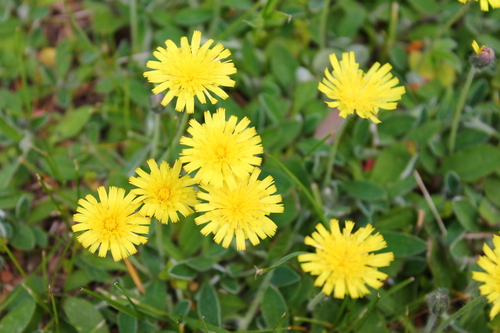
mouse-eared hawkweed
Pilosella officinarum
A hardy and tenacious wildflower, the mouse-eared hawkweed blankets sunny fields with its distinctive lemon-yellow blooms and fuzzy, 'mouse-ear' leaves. While it may be a modest grower, its ability to thrive in the toughest soils makes it a fascinating subject for backyard naturalists.
Quick Identification
Size
Flower stems 5–30 cm (2–12 in) tall; basal leaves 1–12 cm (0.4–4.7 in) long
Colors
Lemon-yellow flower heads, sometimes with distinct red or orange-red stripes on the outer underside of the ray florets; pale grayish-green leaves.
Key Features
- Single lemon-yellow flower head per leafless stem
- Basal rosette of oval leaves covered in long, white bristly hairs
- Creeping above-ground runners (stolons) that form dense mats
- Underside of leaves are felted with white star-shaped hairs
When You’ll See Them
Geographic range
Where Does the mouse-eared hawkweed Live?
Native to the vast temperate stretches of Europe and Northern Asia, the mouse-eared hawkweed can be found from the windswept hills of the United Kingdom across to the plains of Western Siberia. This hardy traveler didn't stop at its native borders; it has successfully established robust populations throughout North America, particularly in the northern United States and Canada, as well as in the cool climates of New Zealand. In these introduced ranges, it often thrives in disturbed soils, rocky pastures, and suburban landscapes where other plants might struggle to find a foothold.
Basemap © OpenStreetMap contributors
Behavior
Mouse-eared hawkweed is a fascinating study in botanical persistence and competition. It is best known for its allelopathic behavior, meaning it releases chemical compounds into the soil that inhibit the germination and growth of neighboring plant species. This biological strategy allows it to create exclusive territories, forming thick, carpet-like mats that can eventually choke out diverse grasses and wildflowers. It spreads aggressively both through wind-dispersed seeds and via its stolons—creeping stems that root at the tips to create new clones of the parent plant.
The plant is highly sensitive to light and environmental conditions. Its flowers exhibit a strong circadian rhythm, opening wide during bright, sunny hours to attract pollinators and closing tightly during rain or at night to protect its pollen. While it is often viewed as a stubborn weed by gardeners and farmers due to its ability to thrive in poor, acidic soils, it is a vital nectar source for a variety of specialized solitary bees and hoverflies.
EverydayEarth exclusive
Camera Tips
To capture the best footage of mouse-eared hawkweed, you need to think small and get low. Because these plants rarely exceed a foot in height, your camera should be mounted on a ground-level stake or even placed directly on a flat stone. Angling the lens slightly upward (about 15-20 degrees) provides a majestic "forest of flowers" perspective that makes the lemon-yellow blooms stand out against the sky. This low angle is also perfect for capturing the fine, white "mouse-ear" hairs on the leaves, which are a defining characteristic of the species.
Time-lapse is the ideal setting for this species. Configure your camera to take a shot every 5 to 10 minutes from sunrise to sunset. This will allow you to see the dramatic way the flowers "wake up" in the morning sun and close back up as the evening light fades. If you are tracking the growth of the plant over a season, a single photo taken at the same time every day will reveal how the creeping stolons march across the ground to claim new territory. Ensure you use a macro lens or a close-focus setting if your hardware allows, as the intricate red striping on the underside of the petals is a beautiful detail often missed by the naked eye.
Since hawkweed is a favorite of pollinators, focus your camera on a particularly vibrant cluster of flowers during peak sunlight hours (typically 10 AM to 2 PM). Set your trigger speed to high or use a video mode to catch solitary bees and hoverflies in action. Be mindful of the sun's position; direct midday sun can wash out the pale yellow color of the petals. Positioning your camera so the sun is at a side angle will highlight the texture of the hairy stems and leaves. If you're using a trail camera, ensure the PIR sensor is sensitive enough or use a timed capture mode, as the plant's movement is generally too slow to trigger motion sensors unless a large insect lands on it.
Similar Species
Species that look similar or are commonly confused with mouse-eared hawkweed.
Common Dandelion
Dandelions have hollow stems and jagged, hairless leaves, whereas hawkweed has solid stems and hairy, oval leaves.
Orange Hawkweed
Identical in growth habit but features vibrant fiery-orange flowers instead of lemon-yellow.
Smooth Hawkweed
Lacks the creeping stolons (runners) and the dense white hairs on the leaves that characterize the mouse-ear variety.
Frequently Asked Questions
Record mouse-eared hawkweed at your habitat
Connect a camera to start building your own species record — AI identifies every visitor automatically.