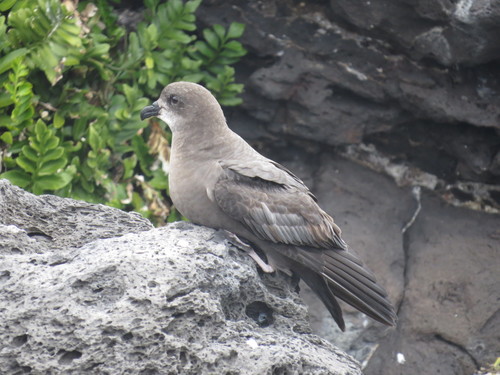
Murphy's Petrel
Pterodroma ultima
A mysterious wanderer of the deep Pacific, Murphy's Petrel spends its life riding the ocean winds. This dark-winged traveler is a master of the air, only touching land on the most remote tropical islands on Earth.
Quick Identification
Size
Length: 38–41 cm (15–16 in); Wingspan: 97 cm (38 in); Weight: 360 g (12.7 oz)
Colors
Uniform dark sooty-grey plumage with a small pale patch on the chin; legs are pinkish-grey with dark webbing and toes; no visible difference between males and females.
Key Features
- Uniformly dark sooty-grey plumage
- Small whitish patch on the chin
- Pinkish legs with black-tipped toes
- High, banking 'gadfly' flight pattern
When You’ll See Them
Geographic range
Where Does the Murphy's Petrel Live?
This elusive seabird is primarily native to the vast expanses of the South Pacific Ocean, with its main breeding colonies located on the remote Pitcairn, Tuamotu, and Austral Islands. Outside of the breeding season, Murphy's Petrels embark on massive trans-equatorial migrations, moving into the North Pacific where they can be found in the deep offshore waters of the United States, Canada, and even as far as the Hawaiian Islands. Because they are strictly oceanic, they are almost never seen from the mainland except during extreme weather events or scientific expeditions.
Basemap © OpenStreetMap contributors
Behavior
On land, Murphy's Petrels are strictly nocturnal, arriving at their breeding colonies under the cover of darkness to avoid predators like frigatebirds. They are relatively silent at sea but become quite vocal at their nesting sites, using a series of chirps and whistles to communicate. Unlike many other seabirds, they do not frequently follow ships, making them a rare and prized sight for offshore birdwatchers.
EverydayEarth exclusive
Camera Tips
Angle your camera slightly upward toward the entrance of the burrow or crevice. Murphy's Petrels often 'crash-land' into the brush before walking to their nests, so a wider field of view is better than a tight shot. Set the camera to take short video clips (15-20 seconds) with audio enabled; the vocalizations are often as important as the visuals for identifying specific individuals or colony activity levels.
For coastal mainland users, your best bet is a high-speed AI camera with a powerful telephoto lens situated on a high bluff overlooking the ocean during 'pelagic' weather. Look for days with strong onshore winds that might push these deep-water birds closer to the coast. Focus on capturing the silhouette and flight style—Murphy's Petrel has a distinctively high, arched banking flight that separates it from smaller shearwaters. While you won't find them in a typical suburban backyard, these tips are essential for the ultimate seabird enthusiast.
Similar Species
Species that look similar or are commonly confused with Murphy's Petrel.
Frequently Asked Questions
Record Murphy's Petrel at your habitat
Connect a camera to start building your own species record — AI identifies every visitor automatically.