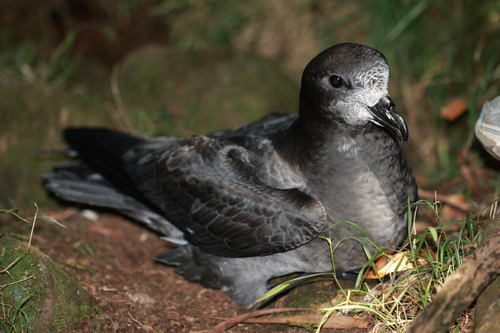
Providence Petrel
Pterodroma solandri
Meet the 'Bird of Providence,' a resilient ocean traveler that transforms from a graceful aerialist into a curious, vocal forest dweller. Once a vital food source for island settlers, these friendly petrels are now a rare and protected treasure of the Tasman Sea.
Quick Identification
Size
Length: 40 cm (16 in); Wingspan: 95–105 cm (37–41 in); Weight: 500 g (1.1 lbs)
Colors
Dark slate-grey to brownish-grey body; distinctive white 'flashes' on the underwings; pale, scalloped grey face; black bill and legs
Key Features
- Robust, heavy-set build for a gadfly petrel
- Prominent white patches on the primary wing feathers
- Strong, hooked black bill
- Pale 'scaly' appearance around the base of the beak
When You’ll See Them
Behavior
The Providence Petrel is legendary among seabirds for its remarkable lack of fear toward humans. On their breeding grounds, they are notoriously curious; historically, they were known to land directly on people who called out to them or made loud noises. While they are master gliders at sea, their behavior on land is somewhat clumsy as they navigate through forest debris to reach their underground burrows.
These birds are highly social during the breeding season, often congregating in large numbers in the air above their colonies before 'crash-landing' through the canopy at dusk. Once on the ground, they become quite vocal, emitting a series of cackles and 'laughing' calls as they interact with mates and defend their nesting sites. They spend most of the year as solitary travelers of the open ocean, returning to the same mountain slopes year after year.
EverydayEarth exclusive
Camera Tips
Capturing the Providence Petrel on camera is a unique challenge due to their specific nesting locations on Lord Howe and Philip Island. To get the best shots, position your camera near the base of large trees or rocky outcrops where burrow entrances are visible. The camera should be mounted low—no more than 12 inches off the ground—to capture their 'shuffling' walk and entrance into their burrows. Use a wide-angle setting to account for the bird's surprisingly large wingspan if it decides to stretch or flap near the lens.
Because these birds are strictly nocturnal on land, your camera’s infrared capabilities are critical. Use 'No-Glow' or 'Black Flash' LEDs to avoid startling the birds or causing overexposure on their white wing patches. Since they move quickly once they hit the ground, set your trigger speed to the fastest possible setting (0.3 seconds or less) and use a 'Burst' mode of 3-5 photos to ensure you capture a clear headshot amidst the movement.
While traditional bait is not used for these protected seabirds, audio lures are exceptionally effective for Providence Petrels. They are famously attracted to noise; playing recordings of their social calls can encourage them to land within the camera's field of view. However, ensure any audio equipment is set to a natural volume and used ethically. If you are setting cameras in a windy area, use a windscreen on your camera's microphone to capture their unique 'laughing' vocalizations without distortion.
Seasonal timing is everything for this species. Aim to have your cameras active during the peak of the breeding season in June and July. During these winter months, activity on the forest floor is at its highest as birds compete for mates and maintain their burrows. Positioning the camera to face toward the interior of the forest, away from the direct coastal wind, will help keep the lens clear of sea spray and salt crusting, which can blur night-vision images.
Similar Species
Species that look similar or are commonly confused with Providence Petrel.
Frequently Asked Questions
Record Providence Petrel at your habitat
Connect a camera to start building your own species record — AI identifies every visitor automatically.