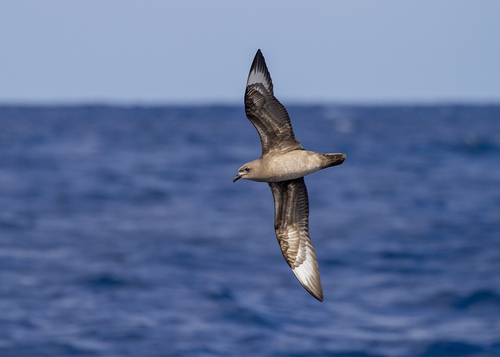
Kermadec Petrel
Pterodroma neglecta
A polymorphic marvel of the Pacific, the Kermadec Petrel is one of the few gadfly petrels brave enough to circle its island home in the full light of day.
Quick Identification
Size
Length of 37-39 cm (14.5-15.5 in); wingspan approximately 100 cm (39 in); weight 430-580g (0.9-1.3 lbs)
Colors
Highly polymorphic; light morphs have white heads and underparts with grey-brown upperparts; dark morphs are entirely sooty brown; all morphs feature a diagnostic white patch at the base of the primary feathers on the underwing.
Key Features
- Distinctive white 'flash' at the base of the underwing primaries
- Polymorphic plumage ranging from near-white to dark chocolate brown
- Short, thick black bill with a hooked tip
- Square-ended tail compared to other gadfly petrels
When You’ll See Them
Geographic range
Where Does the Kermadec Petrel Live?
The Kermadec Petrel is a wide-ranging wanderer of the subtropical and tropical Pacific Ocean. Native to the vast waters between Australia and South America, its core breeding grounds are found on isolated outposts like the Kermadec Islands, Lord Howe Island, and the Juan Fernández archipelago. While they spend much of their lives far from land, these birds are frequently sighted across the southern and central Pacific, occasionally straying toward the coastlines of New Zealand and even North America during their non-breeding dispersal.
Basemap © OpenStreetMap contributors
Behavior
The Kermadec Petrel is an exceptionally aerial seabird, spending the vast majority of its life over the open waves of the Pacific Ocean. Unlike many of its nocturnal relatives in the gadfly petrel family, this species is known for being active during the day around its breeding colonies. They are often seen performing high, arcing flight displays, utilizing the wind to soar effortlessly with minimal wing flapping.
On land, their behavior is clumsy but determined. They are surface-nesters or shallow-burrowers, which distinguishes them from many other petrels that prefer deep underground tunnels. While they are generally solitary at sea, they congregate in loose colonies during the breeding season, where they engage in vocal 'chattering' and aerial chases to establish dominance and pair bonds.
EverydayEarth exclusive
Camera Tips
Capturing the Kermadec Petrel on camera is a specialized task usually reserved for coastal or island-based setups. Because these birds are surface-nesters, camera placement should be low to the ground, approximately 12 to 18 inches high, aimed at known nesting sites under tree canopies or beside rock crevices. Unlike burrowing petrels, they are more visible, but they still prefer the cover of ferns or low-hanging branches to hide from aerial predators.
For those on breeding islands, setting your camera to a 'Hybrid' mode (photo followed by video) is ideal. The photo captures the fast movement as they land, while the video can record their unique 'purring' or 'clucking' vocalizations and social interactions. Use a high-speed SD card to minimize trigger lag, as their landings can be sudden and erratic. Since they are active during the day, ensure your camera is positioned to avoid direct lens flare from the afternoon sun, which is when they are most active near the cliffs.
Do not use food bait, as this can attract invasive predators like rats or cats which are the primary threat to these birds. Instead, focus on 'natural bottlenecks'—the specific ridges or clearings they use to gain lift-off. A wide-angle lens is preferable to capture the bird's full 1-meter wingspan as it approaches or departs the nest. In areas with high humidity or sea salt spray, use a protective housing or wipe the lens regularly to maintain clarity.
Similar Species
Species that look similar or are commonly confused with Kermadec Petrel.
Herald Petrel
The Herald Petrel has a slightly different underwing pattern and generally smaller bill; its vocalizations are distinctively higher-pitched.
Murphy's Petrel
Murphy's Petrel lacks the white primary flashes on the underwing and is more uniformly greyish-brown.
Trindade Petrel
Nearly identical in flight, the Trindade is found primarily in the Atlantic, whereas the Kermadec is a Pacific specialist.
Frequently Asked Questions
Record Kermadec Petrel at your habitat
Connect a camera to start building your own species record — AI identifies every visitor automatically.