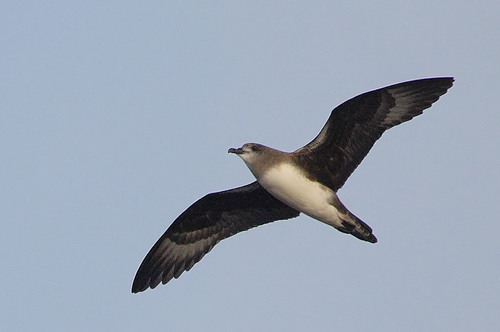
Herald Petrel
Pterodroma heraldica
A master of the southern winds, the Herald Petrel is a mysterious wanderer of the South Pacific and Indian Oceans. With its dramatic flight and varied plumage, it remains one of the most enigmatic seabirds for coastal observers and island explorers alike.
Quick Identification
Size
Length of 35–39 cm (14–15 in), wingspan of 88–102 cm (35–40 in), weighing approximately 280–380 g (10–13 oz)
Colors
Highly variable plumage morphs ranging from pale (grey-brown upperparts, white underparts) to dark (entirely soot-brown), with distinctive white patches at the base of the primary feathers.
Key Features
- Broad, rounded wings with a white flash at the base of the primaries
- Short, stout black hooked bill
- Pale, intermediate, and dark color morphs existing within the same population
- Graceful, high-arching flight pattern typical of gadfly petrels
When You’ll See Them
Geographic range
Where Does the Herald Petrel Live?
Native to the tropical and subtropical waters of the Southern Hemisphere, the Herald Petrel is most commonly found across the vast South Pacific and Indian Oceans. Its core breeding range includes remote island groups such as the Pitcairn Islands, French Polynesia, Easter Island, and Tonga, with a smaller, distinct population located on Round Island near Mauritius. While they are occasionally sighted as vagrants near the Australian or American coasts, they primarily remain in deep oceanic waters far from continental landmasses.
Basemap © OpenStreetMap contributors
Behavior
The Herald Petrel is a quintessential 'gadfly' petrel, known for its spirited and acrobatic flight. They spend most of their lives far out at sea, utilizing high-speed glides and steep arcs to navigate the wind currents above the waves. Unlike many other seabirds that follow fishing vessels, Herald Petrels are generally solitary and pelagic, rarely approaching ships or coastal areas unless returning to their breeding grounds.
On their nesting islands, their behavior changes significantly. To avoid aerial predators like frigatebirds or skuas, they often become more active at the colonies during the late afternoon or at night. They are known for their haunting, whistling calls and 'chattering' vocalizations when interacting with mates or defending nesting crevices. While they are clumsy on land due to their specialized seafaring anatomy, they are fierce defenders of their burrows.
EverydayEarth exclusive
Camera Tips
Capturing a Herald Petrel on camera is a unique challenge because they spend most of their time over the open ocean. If you are on a known breeding island, the best placement for an AI-powered camera is on high, rocky ridges or near the entrances of nesting crevices. Because these birds can be clumsy when landing, aim your camera at a flat 'landing pad' area near a burrow entrance, keeping the lens about 12-18 inches off the ground to capture their low-profile waddle.
Since Herald Petrels are often active at the colony during the twilight hours or late into the night, high-quality infrared (IR) night vision is essential. Ensure your camera's trigger speed is set to its fastest setting; these birds are remarkably quick when they swoop in from the sea. Avoid using white-light flashes, as this can disorient the birds or attract unwanted predators to the nesting site.
For those living on coastal overlooks, a camera with a wide-angle lens pointed toward the ocean can sometimes capture their high-arching flight patterns, though they rarely come close to the shore. If you are setting up a long-term station, use a waterproof housing and a desiccant pack inside the camera body, as the salty sea air and tropical humidity can quickly corrode electronics. Solar panels are highly recommended for remote island setups where battery swaps are difficult.
Similar Species
Species that look similar or are commonly confused with Herald Petrel.
Kermadec Petrel
Slightly larger with prominent white patches on the upper surface of the wings.
Trindade Petrel
Extremely similar but found primarily in the Atlantic Ocean; usually distinguished by range.
Murphy's Petrel
Lacks the white primary bases on the underwing and has a more uniform grey-brown appearance.
Frequently Asked Questions
Record Herald Petrel at your habitat
Connect a camera to start building your own species record — AI identifies every visitor automatically.