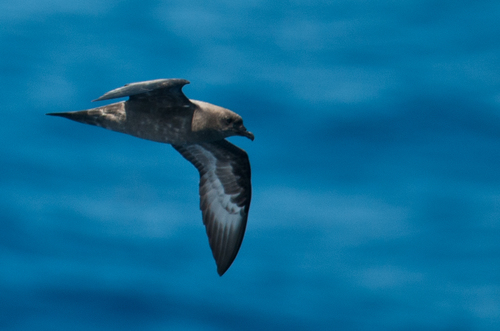
Trindade Petrel
Pterodroma arminjoniana
A master of the Atlantic winds, the Trindade Petrel is a rare and striking seabird known for its acrobatic flight and mysterious life on remote volcanic islands.
Quick Identification
Size
Length: 35–39 cm (14–15 in); Wingspan: 88–102 cm (35–40 in); Weight: 300–450 g (10.5–15.8 oz)
Colors
Highly polymorphic; ranges from a dark phase (sooty-brown all over) to a light phase (white belly and breast with grey-brown upperparts). Most show a pale patch at the base of the primary wing feathers.
Key Features
- High-arcing, 'gadfly' flight pattern
- Short, stout, hooked black beak
- Prominent white patches on the underwing primaries
- Polymorphic plumage ranging from dark chocolate to white-bellied
When You’ll See Them
Behavior
The Trindade Petrel is a true wanderer of the open ocean, belonging to the 'gadfly' group of petrels known for their erratic, high-speed flight. They spend the vast majority of their lives far from land, touching down only to breed on remote, volcanic islands. In flight, they are acrobatic masters, using a technique called dynamic soaring to wheel high into the air before diving back toward the waves, rarely flapping their wings.
On their breeding grounds, these birds become surprisingly vocal, emitting chattering and cackling calls as they compete for nesting sites. They are generally solitary when at sea but can be found in loose colonies during the nesting season. Unlike many other seabirds, they are quite aggressive in defending their rocky crevices from intruders, using their sharp, hooked bills to deter rivals.
EverydayEarth exclusive
Camera Tips
Capturing a Trindade Petrel on camera is a specialized task because they only come to land on remote, rugged islands like Trindade or Round Island. To successfully monitor them, focus your camera placement on the entrances of nesting crevices or rocky ledges. Position the camera 2 to 4 feet from the burrow entrance, angled slightly upward to capture the bird's arrival. Since these petrels are most active at the colony during twilight and night to avoid predators, high-quality infrared (IR) night vision is non-negotiable.
Use 'No-Glow' IR settings to avoid disturbing the birds, as bright flashes can disorient them in the dark. Because they move quickly when landing, set your camera's trigger speed to its fastest possible setting (ideally under 0.2 seconds). For those trying to capture their iconic high-speed flight, place cameras on high, wind-swept ridges overlooking the ocean. Use a 'Burst Mode' or 'Multi-Shot' setting to ensure you catch the bird in the frame during its rapid, sweeping passes.
Traditional food baits will not work for this species, but acoustic lures are a powerful tool for researchers. Playing recordings of Trindade Petrel calls can draw curious birds toward a camera's field of view. If you are using an AI-powered camera, ensure it is configured to trigger on fast-moving 'large birds,' as their erratic flight can sometimes be ignored by sensors tuned for slower-moving land animals.
Similar Species
Species that look similar or are commonly confused with Trindade Petrel.
Frequently Asked Questions
Record Trindade Petrel at your habitat
Connect a camera to start building your own species record — AI identifies every visitor automatically.