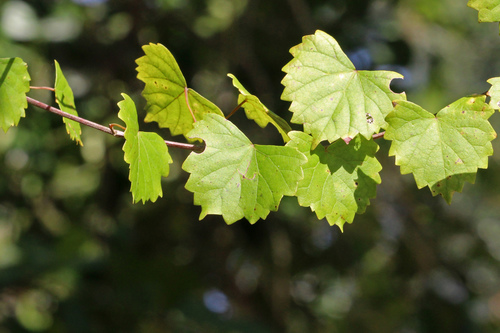
muscadine
Vitis rotundifolia
The soul of the Southern landscape, the muscadine is more than just a vine—it's a thriving hub for backyard biodiversity. From its bronze-hued fruit to its twisting woody stems, this native grape offers a front-row seat to the secret lives of birds and mammals.
Quick Identification
Size
Vine length of 60–100 ft (18–30 m); fruit diameter 1–1.5 in (2.5–3.8 cm)
Colors
Dark green leaves; fruit ranges from greenish-bronze to deep purple or near-black
Key Features
- Thick-skinned, large individual grapes
- Heart-shaped leaves with coarse, serrated edges
- Smooth, non-shredding bark even on older vines
- Unbranched tendrils used for climbing
When You’ll See Them
Behavior
Muscadines are vigorous, woody vines known for their incredible resilience and longevity in the American South. Unlike many other grape species, they thrive in high heat and humidity, often out-competing other vegetation to reach the forest canopy. They act as a foundational species in many backyard ecosystems, providing both a structural framework for nesting and a high-energy food source during the late summer months.
As a deciduous plant, the muscadine goes through a dramatic seasonal cycle. In the spring, it pushes out lush, bright green growth that provides dense cover for nesting birds. By late summer, the vine shifts its energy into fruit production. While they are self-sufficient, in a backyard setting, they often interact with humans by colonizing fences and arbors, where they are prized for their unique, musky-sweet fruit that differs significantly from standard table grapes.
EverydayEarth exclusive
Camera Tips
To capture the true magic of a muscadine vine, you shouldn't just point the camera at the leaves; you need to focus on the 'wildlife highway' the vine creates. During the late summer ripening phase (August to September), position your camera at a slight downward angle toward a heavy cluster of fruit. This is when you will capture the highest diversity of visitors, from Cedar Waxwings and Northern Cardinals during the day to Gray Foxes and Raccoons at night who scavenge the fallen grapes.
If your muscadine is growing along a fence or trellis, mount your camera approximately 4 to 5 feet off the ground, aiming parallel to the vine's main 'runner.' Many climbing mammals, like Opossums and Squirrels, use the thick, woody stems as a natural bridge. Using a 'Hybrid' mode (photo followed by video) is ideal here, as it allows you to identify the species with a high-res still and then observe their feeding behavior or social interactions through video.
For those interested in the botanical growth, set your camera to time-lapse mode during the late spring. Aim it at a fresh tendril near a support structure. You can often record the vine's 'searching' motion as it circles through the air to find a grip. Ensure your PIR (passive infrared) sensitivity is set to 'High' if you are targeting birds, as their small heat signatures and fast movements can sometimes be missed by slower triggers.
Don't forget the ground level! Fallen muscadines are a magnet for ground-dwelling wildlife. Place a camera 12 inches off the ground near the base of the vine. You’ll often catch surprising footage of Box Turtles or even White-tailed Deer who stop by for a fermented treat. Just be sure to wipe the lens frequently, as the sugary sap and insect activity around the fruit can quickly smudge your view.
Similar Species
Species that look similar or are commonly confused with muscadine.
Frequently Asked Questions
Record muscadine at your habitat
Connect a camera to start building your own species record — AI identifies every visitor automatically.