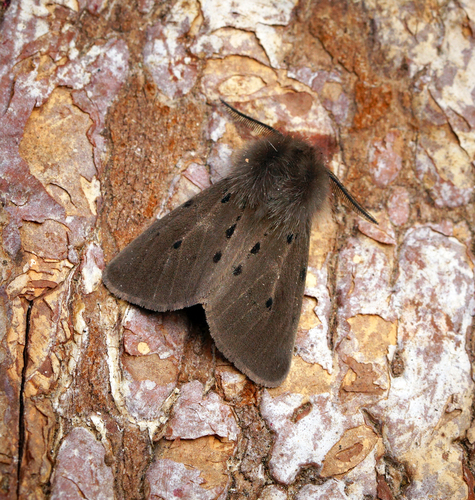
Muslin Moth
Diaphora mendica
The Muslin Moth is a master of disguise and transformation, featuring a unique look for both males and females. Discover this ghostly nocturnal beauty that frequents garden lights every spring.
Quick Identification
Size
Wingspan of 28-38 mm (1.1-1.5 inches)
Colors
Striking sexual dimorphism: females are translucent milky white with sparse black dots; males are smoky brownish-grey with similar dark spotting.
Key Features
- Translucent, 'muslin-like' wings
- Sparse black dots on forewings
- Males are dark grey while females are white
- Thick, furry white or grey thorax
When You’ll See Them
Behavior
The Muslin Moth is a fascinating example of sexual dimorphism in the moth world. While the females are bright white to signal a warning to predators, the males sport a drabber, smoky-grey coat that helps them blend into the shadows. They are strictly nocturnal and are most frequently encountered when they are drawn to artificial light sources during the late spring and early summer months.
Interestingly, adult Muslin Moths do not feed. They emerge from their cocoons with all the energy they need to find a mate and lay eggs, living only for a short period. During the day, they can be found resting on low-growing vegetation or walls, often holding their wings in a tent-like fashion over their bodies. They are generally docile and will remain perfectly still unless disturbed.
EverydayEarth exclusive
Camera Tips
To capture the Muslin Moth on camera, your best bet is to set up a 'moth wall.' Hang a white cotton sheet against a fence or wall and shine a strong UV or bright LED light directly onto it. Place your camera on a tripod nearby, ideally with a macro lens or a high-resolution sensor that can capture the fine details of the moth’s furry thorax and translucent wing scales. Set your camera to a fast shutter speed if you are hoping to catch them in flight, or a longer exposure for resting shots.
Because these moths are small, proximity is everything. If you are using an AI-powered backyard camera, position it within 12-18 inches of a known 'landing zone' like a porch light or a specific flowering plant. Since the Muslin Moth is most active during the peak of spring, ensure your camera is positioned to avoid glare from the rising sun, as many moths will linger on surfaces until dawn. Use a 'motion-trigger' setting with high sensitivity to capture them as they flutter toward the light.
For the best results, focus on the differences between the sexes. The white females are highly reflective, so you may need to turn down your camera's exposure compensation to avoid 'blowing out' the highlights on their wings. Conversely, the smoky-grey males require a bit more light to reveal the subtle spotting. If your camera has a 'night vision' or infrared mode, the Muslin Moth’s eyes will often glow with a distinct eyeshine, making for a dramatic and ethereal photograph.
Finally, consider the environment around the camera. Planting host species like dandelions or broad-leaved docks nearby will encourage females to visit your garden to lay eggs. If you find a caterpillar (a 'woolly bear' type with reddish-brown hair), you can track its progress as it prepares to pupate, giving you a head start on where the next generation of adults will emerge.
Similar Species
Species that look similar or are commonly confused with Muslin Moth.
White Ermine
The White Ermine has a much denser pattern of black spots and opaque, snow-white wings compared to the translucent look of the female Muslin Moth.
Water Ermine
Much rarer and found primarily near wetlands; it lacks the grey male form and generally has significantly fewer or no spots on the wings.
Frequently Asked Questions
Record Muslin Moth at your habitat
Connect a camera to start building your own species record — AI identifies every visitor automatically.