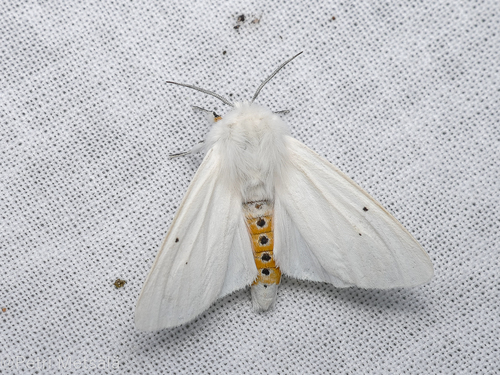
Water Ermine
Spilosoma urticae
A ghostly beauty of the night, the Water Ermine captivates with its pristine, snowy-white wings. This elusive moth is a master of the midnight garden, appearing like a pale spark against the summer darkness.
Quick Identification
Size
Wingspan of 38–46 mm (1.5–1.8 inches)
Colors
Brilliant snowy white wings and thorax; typically zero to two tiny black dots on the forewings; yellow abdomen with black spots often hidden by wings
Key Features
- Pure snowy white coloration
- Minimal to no black spotting on the forewings
- White, feathery (pectinate) antennae in males
- Stocky, hairy white thorax
When You’ll See Them
Behavior
The Water Ermine is a sophisticated nocturnal moth that spends its daylight hours hidden deep within dense vegetation or resting on the undersides of leaves. Its stark white coloration serves as a surprisingly effective defense; in the dappled light of a garden or meadow, it can be easily mistaken for a bird dropping or a stray petal, discouraging predators from taking a closer look.
As adults, Water Ermines do not feed at all, as they lack functional mouthparts. Their entire adult life—usually lasting only a few weeks—is dedicated to the search for a mate and, for females, finding the perfect host plants to lay eggs. They are strong but erratic fliers, frequently seen spiraling toward artificial light sources on warm summer nights. While they are often solitary, you may see multiple individuals in high-quality habitats like damp meadows or near light traps.
EverydayEarth exclusive
Camera Tips
To successfully capture the Water Ermine on your backyard camera, you need to leverage their natural attraction to light. The most effective setup involves hanging a white cotton sheet vertically and illuminating it with a UV (blacklight) or a high-output LED bulb. Position your camera on a tripod approximately 2 to 4 feet from the sheet. By using a white backdrop, you provide a high-contrast surface that allows the camera's AI to easily lock focus on the moth's silhouette and wing details.
Lighting is the biggest challenge when photographing this species because their snowy white wings are highly reflective. If your camera has adjustable settings, try reducing the exposure compensation by -1.0 or -2.0 to prevent the white wings from 'blowing out' into a featureless white blob. If using a flash, use a diffuser—even a piece of white parchment paper taped over the flash can work—to soften the light and reveal the delicate wing veins and the few characteristic black dots that define the species.
For the best results, place your camera near 'wild' corners of your yard where plants like nettles or docks grow, as these are the primary nurseries for Water Ermine caterpillars. Temperature and humidity play a massive role in activity; you are five times more likely to capture a Water Ermine on a warm, humid, and overcast night than on a clear, cool evening. Set your camera to a high-sensitivity motion trigger or a short-interval time-lapse (every 20-30 seconds) to ensure you catch them during their brief visits to your light station.
Similar Species
Species that look similar or are commonly confused with Water Ermine.
Frequently Asked Questions
Record Water Ermine at your habitat
Connect a camera to start building your own species record — AI identifies every visitor automatically.