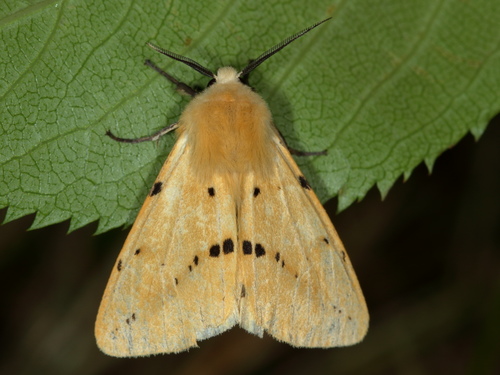
Buff Ermine
Spilosoma lutea
A charming nocturnal visitor, the Buff Ermine is easily recognized by its warm, buttery wings and delicate black speckling. Often found in backyards across Europe and Asia, this 'ermine-furred' moth is a highlight of any summer night-watching session.
Quick Identification
Size
Wingspan of 34–42 mm (1.3–1.7 inches)
Colors
Creamy buff to pale yellow wings with variable black spotting; the abdomen is notably yellow with black dots.
Key Features
- Pale buff to ochre-yellow wing color
- Scattered black dots usually forming a diagonal line toward the wing tip
- Furry white or yellowish thorax
- Yellow abdomen with distinct black spots
When You’ll See Them
Geographic range
Where Does the Buff Ermine Live?
Native to the vast temperate regions of the Palearctic, the Buff Ermine is widely distributed across Europe and Northern Asia. Its territory extends from the British Isles and Western Europe through Russia and Central Asia, reaching as far east as China, Korea, and Japan. It is a highly adaptable species found in almost any environment where its diverse larval host plants are present, from sea level up into moderate mountain altitudes.
Basemap © OpenStreetMap contributors
Behavior
The Buff Ermine is a nocturnal moth that spends its daylight hours hiding in dense vegetation or resting on the undersides of leaves. Its pale coloration provides excellent camouflage against sun-speckled leaves or dried grass. When night falls, it becomes an active flyer, often seen fluttering around garden lights or windows. Like many moths in the Erebidae family, it has an erratic flight pattern that helps it evade predators like bats.
One of its most interesting behaviors is a defense mechanism known as thanatosis, or feigning death. If a Buff Ermine feels threatened or is touched, it will often drop to the ground and lie perfectly still, sometimes curling its abdomen to reveal its warning colors. While they are generally solitary, you might find several congregating near a particularly bright light source during the peak of their breeding season.
EverydayEarth exclusive
Camera Tips
To capture the Buff Ermine on camera, you should utilize their natural attraction to ultraviolet light. Setting up a 'moth wall' is the most effective method: hang a white cotton sheet vertically and shine a UV or bright LED light onto it. Position your camera on a tripod 3–5 feet away, focused specifically on the center of the sheet where moths are likely to land and rest.
Because these moths are relatively small, a camera with macro capabilities or a close-focus lens is essential. If using a standard trail camera, look for one with a high-resolution sensor and set it to 'Photo' or 'Hybrid' mode with a short trigger interval. Since the sheet acts as a giant reflector, you may need to reduce your camera's exposure settings or use a physical diffuser over the flash to prevent the moth's pale wings from appearing as a white blur.
Placement should be in a sheltered area of your yard, away from heavy wind, ideally near 'wild' patches where nettles or long grass grow. The best time for recording is during warm, humid nights with little moon brightness, as the contrast of your light trap will be most effective then. Seasonal timing is key; in most temperate regions, your best chances are between late May and mid-July when the adults are in their flight period.
Similar Species
Species that look similar or are commonly confused with Buff Ermine.
White Ermine
Similar size and spotting, but has pure white wings rather than the creamy buff-yellow of Spilosoma lutea.
Water Ermine
Much whiter and often has fewer or no spots; typically found in much damper, marshy habitats.
Muslin Moth
The female Muslin Moth is white with spots, but the male is a smoky brown; both lack the yellowish-buff tone of the Buff Ermine.
Frequently Asked Questions
Record Buff Ermine at your habitat
Connect a camera to start building your own species record — AI identifies every visitor automatically.