Nebraska sedge
Carex nebrascensis
The ironclad architect of Western wetlands, Nebraska Sedge is a stunning blue-green perennial that transforms muddy banks into thriving wildlife sanctuaries.
Quick Identification
Size
Height ranges from 20 to 90 cm (8 to 36 inches); forms dense colonies spreading several meters via underground rhizomes.
Colors
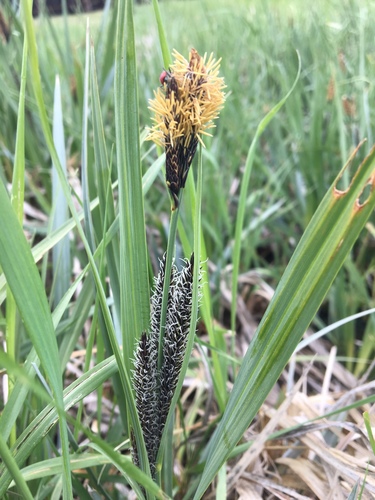
Distinctive glaucous blue-green or silvery-gray foliage; flower and seed spikes are dark brown to charcoal black.
Key Features
- Triangular 'edged' stems characteristic of the sedge family
- Waxy, bluish-green leaf blades that feel slightly rough
- Upright, dark brownish-black seed spikes (inflorescences)
- Extensive creeping rhizome system that creates thick sod.
When You’ll See Them
Geographic range
Where Does the Nebraska sedge Live?
Native to the sun-drenched landscapes of Western North America, the Nebraska sedge finds its home across a vast territory spanning from the southern reaches of British Columbia and Alberta down through the central and western United States into Northern Mexico. It is particularly dominant in the Great Basin, the Rocky Mountains, and the Sierra Nevada range, where it colonizes moist meadows and riparian corridors. This hardy plant is a staple of the American West, thriving in both high-altitude alpine wetlands and lowland marshes wherever steady moisture can be found.
Basemap © OpenStreetMap contributors
Behavior
Nebraska sedge is a perennial wetland 'architect' that grows in aggressive, dense colonies. Unlike many grasses that grow in isolated bunches, this sedge uses its thick network of underground rhizomes to stabilize soil and claim territory in saturated environments. It is a fundamental species for bank stabilization, often preventing erosion during spring snowmelts and heavy rain events by knitting the soil together with its deep root system.
Ecologically, Nebraska sedge acts as both a nursery and a fortress. Its stiff, upright growth provides essential nesting cover for waterfowl and red-winged blackbirds, while the submerged portions of the plant offer refuge for amphibians and aquatic insects. For humans, it is a key species in riparian restoration projects, as it is highly resilient to grazing and can filter pollutants from runoff before they reach open water.
EverydayEarth exclusive
Camera Tips
When using an AI-powered camera to capture Nebraska sedge, think of the plant as a natural 'blind' or stage. Place your camera at a low angle, roughly 12 to 18 inches above the ground, facing a dense patch of the sedge near a water source. This positioning allows you to capture the small mammals, such as voles or muskrats, that use the sedge's 'runways' for travel, as well as ground-nesting birds that retreat into the thick foliage for safety.
To capture the plant's unique aesthetic, utilize time-lapse settings during the late spring and early summer. The way the glaucous blue-green leaves catch the morning light is striking, and a time-lapse can show the rapid development of the dark seed spikes. If your camera supports it, set a high trigger sensitivity; the sedge moves beautifully in the wind, but you want to ensure the AI differentiates between the swaying leaves and the movement of a hidden animal emerging from the stalks.
Because Nebraska sedge grows in wet areas, mounting your camera on a sturdy, waterproof t-post or a weighted tripod is essential. Avoid placing the camera directly on the mud, as the rising water table in these habitats can quickly submerge expensive gear. For the best color results, aim for 'golden hour' lighting (early morning or late afternoon), which emphasizes the silvery-blue hue of the leaves against the dark, contrasting seed heads.
During the winter, Nebraska sedge often turns a golden-brown but remains upright even under light snow. This creates an excellent backdrop for capturing winter wildlife. Keep your camera active year-round in these spots, as the dense cover provides one of the few reliable shelters for backyard wildlife during the colder months when other deciduous plants have lost their leaves.
Similar Species
Species that look similar or are commonly confused with Nebraska sedge.
Frequently Asked Questions
Record Nebraska sedge at your habitat
Connect a camera to start building your own species record — AI identifies every visitor automatically.