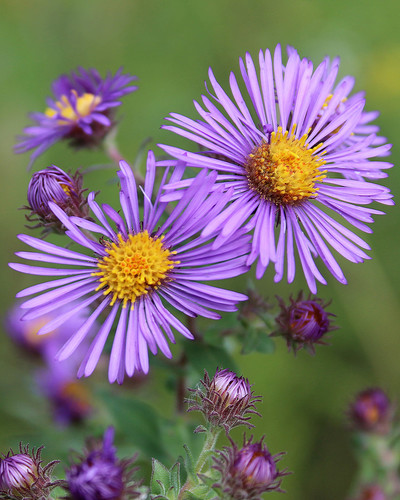
New England aster
Symphyotrichum novae-angliae
The New England aster is the undisputed royalty of the autumn garden, offering a vibrant explosion of purple just as the rest of the landscape fades. A critical nectar source for migrating Monarchs, this hardy wildflower is a must-have for any backyard wildlife enthusiast.
Quick Identification
Size
Height of 30–120 cm (1–4 ft); spread of 60–90 cm (2–3 ft)
Colors
Bright purple to deep violet (rarely pink or white) petals with bright yellow centers that turn reddish-purple with age
Key Features
- Daisy-like flowers with 30–100 thin ray petals
- Sturdy, hairy stems that feel rough to the touch
- Leaves that 'clasp' the stem at the base
- Yellow central disks that transition to a rusty red
- Bushy, multi-branched late-season growth
When You’ll See Them
Behavior
New England aster is a standout performer in the late-summer and autumn garden, acting as a grand finale for the growing season. Unlike many spring ephemeral flowers, this perennial spends the early months of the year quietly building a robust structure of leafy, hairy stems. It is a social hub for wildlife; as the days grow shorter and other nectar sources disappear, this plant becomes a frantic site of activity for pollinators preparing for winter or migration.
In the wild, these plants exhibit a colonial growth habit, spreading through both wind-dispersed seeds and underground rhizomes. They are known for 'losing their lower leaves' as the season progresses, a natural behavior where the plant redirects energy to its heavy floral display at the top. While they are hardy and can withstand the first few light frosts, they eventually go dormant, providing structural interest and seeds for small birds throughout the winter months.
EverydayEarth exclusive
Camera Tips
To capture the stunning detail of New England aster, mount your camera on a steady stake or tripod at a height of 3 to 4 feet. Because these plants are magnets for pollinators, you should position the lens close to a cluster of active blooms—ideally about 12 to 24 inches away—to catch the high-speed visits of bees and butterflies. AI-powered cameras with macro capabilities or 'pet' modes are often surprisingly good at locking onto the movement of large insects against the purple background of the petals.
Timing is critical for lighting. The deep purple of the New England aster can 'wash out' or look blue in harsh midday sun. For the most color-accurate photos, capture your images during the 'golden hour' shortly before sunset. This warm light makes the yellow centers of the flowers glow. However, if you are looking for wildlife action, the hours between 11 AM and 2 PM will provide the most movement, as this is when butterflies like the Monarch are most active. Ensure your camera is set to a high shutter speed or 'sports mode' to freeze the wings of visiting insects.
Because the stems of the aster are tall and prone to swaying in the wind, motion-triggered cameras can sometimes produce 'false positives.' To prevent this, try to shield the plant from heavy wind or use a secondary stake to gently stabilize the main flowering stem. If you are using a camera with time-lapse capabilities, start your sequence in early September. Watching the tight green buds explode into a wall of purple over the course of two weeks makes for a spectacular visual record of the changing seasons in your backyard.
Similar Species
Species that look similar or are commonly confused with New England aster.
Frequently Asked Questions
Record New England aster at your habitat
Connect a camera to start building your own species record — AI identifies every visitor automatically.