Nile Monitor
Varanus niloticus
Meet Africa's most versatile aquatic predator. From the ancient banks of the Nile to the modern canals of Florida, this powerful lizard is a master of land, water, and survival.
Quick Identification
Size
120-220 cm (3.9-7.2 ft) in length; weight typically 5-15 kg (11-33 lbs), with exceptional specimens reaching 20 kg (44 lbs).
Colors
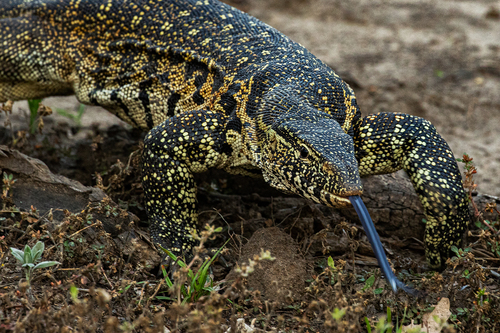
Dark olive, brownish-gray, or black body with prominent yellow or cream-colored spots (ocelli) arranged in 6-9 rows across the back. The underside is yellowish with blackish cross-bars.
Key Features
- Long, powerful tail that is laterally compressed for swimming
- Sharp, curved claws used for climbing, digging, and defense
- Deeply forked, blue-black tongue
- Pointed snout with nostrils located halfway between the eyes and the tip.
When You’ll See Them
Sightings on EverydayEarth
Jul 13, 2026
A Nile Monitor is basking in the bright morning sunlight on a large, flat rock at the edge of a watering hole. The large lizard remains stationary throughout the sequence, likely thermoregulating to increase its body temperature.
Jul 8, 2026
A small pod of hippos is gathered at the edge of a watering hole. Several are resting on the muddy bank, while others remain partially submerged in the water. A Nile monitor lizard swims steadily across the foreground, passing a large submerged log.
Jul 4, 2026
An Egyptian Goose stands alert on a large rock near the water. Behind it, a Nile Monitor is visible basking motionlessly on the same rock surface. Small birds are heard chirping in the background as the goose occasionally turns its head to survey the surroundings.
Jun 24, 2026
An adult hippopotamus and a juvenile rest together on a muddy bank at the water's edge, soaking in the morning light. They appear peaceful, with only minor movements such as ear twitches. In the foreground, a Nile Monitor lizard basks on a large fallen log that extends across the watering hole.
Jun 22, 2026
A Nile Monitor is basking on a large, flat rock at the edge of a watering hole. It remains relatively still, soakng up the sun while occasionally tilting its head to monitor the area.
Jun 15, 2026
A large Nile Monitor is seen basking on a sun-drenched rock beside a watering hole. The lizard remains mostly motionless throughout the sequence, likely absorbing heat from the sun, with only subtle movements of its head and throat visible as it breathes.
Geographic range
Where Does the Nile Monitor Live?
Native to the African continent, the Nile Monitor is found across almost the entirety of Sub-Saharan Africa, stretching from the southern tip of the continent up through the Nile River valley into Egypt. It thrives in nearly every environment with a permanent water source, avoiding only the most extreme deserts. Beyond its native range, the species has established significant invasive populations in the United States, specifically throughout the coastal counties and canal systems of Southern Florida.
Basemap © OpenStreetMap contributors
Behavior
The Nile Monitor is a highly intelligent and versatile predator that spends its time divided between land and water. As a diurnal species, it is most active during the heat of the day, often seen basking on rocks or thick tree branches overhanging water. They are exceptional swimmers, using their rudder-like tails to propel themselves, and can remain submerged for up to 30 minutes to escape predators or hunt for aquatic prey. On land, they are surprisingly fast runners and capable climbers, often retreating into trees or burrows when threatened.
While generally wary of humans, Nile Monitors are known for their defensive displays, which include loud hissing, inflating their throats, and using their tails as powerful whips. In areas where they have become invasive, such as Florida, they have adapted well to suburban environments, frequently utilizing backyard canals and drainage systems. They are solitary animals, coming together only for mating or occasionally around a large carcass.
EverydayEarth exclusive
Camera Tips
To capture a Nile Monitor on your backyard or trail camera, focus your efforts on the transition zones between land and water. Place your camera 6 to 12 inches off the ground, angled toward a known basking spot—usually a flat rock, a fallen log, or a sunny patch of bank near a canal or pond. Because these reptiles are cold-blooded, they must bask to regulate their temperature, making these stationary periods the best time for clear, high-quality photos.
Scent is the most effective way to draw a monitor into your camera's field of view. They have a highly developed sense of smell and will travel long distances to investigate potential food. You can use a 'scent station' by placing a perforated tin of sardines or a small amount of fish oil near your setup. Ensure the bait is secured or protected so the monitor (or other scavengers) doesn't simply walk off with it immediately. If you are in a region where they are invasive, check local regulations before using food lures.
Set your camera to take bursts of 3-5 photos or short video clips. Nile Monitors move with a flickering, jerky motion of the head and tongue, and a single shot might catch them mid-blur. High-speed triggers are essential because once they decide to move, they can be remarkably fast. In the summer months, focus on the mid-morning hours when they first emerge to heat up; in cooler weather, they may stay active later into the afternoon to maximize sun exposure.
Similar Species
Species that look similar or are commonly confused with Nile Monitor.
Frequently Asked Questions
Record Nile Monitor at your habitat
Connect a camera to start building your own species record — AI identifies every visitor automatically.