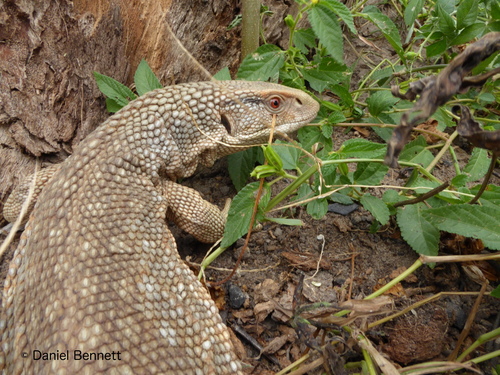
Savannah Monitor
Varanus exanthematicus
The Savannah Monitor is a stocky, powerful lizard that embodies the spirit of the African plains. With its blunt snout and distinctive blue tongue, it is a fascinating subject for any wildlife observer.
Quick Identification
Size
2.5 to 4 feet (75–120 cm) in length; typically weighs 4 to 11 lbs (1.8–5 kg)
Colors
Tan, sandy brown, or greyish-brown with circular yellow or cream-colored spots (ocelli) arranged in rows across the back. The underbelly is a lighter cream or yellow.
Key Features
- Stocky, heavy-set body with a short neck and tail
- Blunt, rounded snout with lateral nostrils
- Forked blue tongue
- Large, protective scales on the back of the neck
When You’ll See Them
Geographic range
Where Does the Savannah Monitor Live?
The Savannah Monitor is native to the vast sub-Saharan African continent. Its range forms a wide band across the middle of Africa, stretching from the Atlantic coast in the west to the Nile River valley in the east. They are most commonly found in countries like Senegal, Ghana, Nigeria, and Sudan, where the landscape provides the open grasslands they crave. While they are a staple of the global pet trade, they have not established significant invasive populations outside of Africa, remaining a true icon of the African plains.
Basemap © OpenStreetMap contributors
Behavior
Savannah Monitors are strictly diurnal, meaning they are active during daylight hours. They spend much of their morning basking on rocks or termite mounds to regulate their body temperature before beginning their daily search for food. Unlike many of their monitor cousins, they are highly terrestrial and are not particularly fond of swimming or climbing, preferring to stay firmly on the ground where they can dig into the soil.
These lizards are solitary and can be quite territorial. When they feel threatened, they employ a dramatic defensive posture: they puff their bodies up with air to appear larger, hiss loudly, and may lash out with their powerful, whip-like tails. During the hottest or driest parts of the year, they often retreat into deep burrows or abandoned termite mounds to conserve moisture and energy.
EverydayEarth exclusive
Camera Tips
To capture the best footage of a Savannah Monitor, you need to think low. These are ground-dwelling reptiles that rarely lift their bellies far from the earth, so mount your camera just 6 to 10 inches off the ground. Aiming the lens at a slight upward angle from a low position provides a dramatic, 'dinosaur-like' perspective that highlights their powerful build and flickering blue tongues.
Because they are cold-blooded, monitors are predictable. Look for 'basking hubs'—flat rocks, fallen logs, or the base of termite mounds that receive direct morning sunlight. Placing your camera here is your best bet for high-quality, stationary shots. Set your trigger interval to be very short, as they can move surprisingly quickly once they have warmed up and are ready to hunt.
While traditional bait isn't necessary, you can pique their curiosity using scent. Monitors have an incredible sense of smell. Placing a few crushed snail shells or even a small amount of damp leaf litter from an area with high insect activity near the camera can encourage them to linger and investigate the area with their tongues, providing excellent close-up 'tongue-flicking' footage. Use a high-speed video setting if possible to catch the rapid movement of their tongue and eyes.
Similar Species
Species that look similar or are commonly confused with Savannah Monitor.
Frequently Asked Questions
Record Savannah Monitor at your habitat
Connect a camera to start building your own species record — AI identifies every visitor automatically.