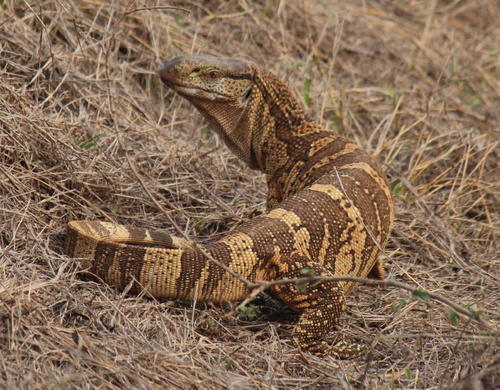
Rock Monitor
Varanus albigularis
Africa's largest lizard is a master of the savanna, combining prehistoric power with surprising intelligence and a calm, stoic nature.
Quick Identification
Size
Total length of 1 to 2 metres (3.3 to 6.6 feet); weight typically between 5 and 17 kg (11 to 37 lbs).
Colors
Mottled grey-brown base with rows of yellowish-white blotches; throat and underside are consistently pale cream or white.
Key Features
- Blunt, bulbous snout unlike the pointed snouts of other monitors
- Heavy, stocky build with powerful clawed feet
- Thick tail that is nearly as long as the body
When You’ll See Them
Geographic range
Where Does the Rock Monitor Live?
The Rock Monitor is native to the vast landscapes of Sub-Saharan Africa, possessing one of the broadest distributions of any African lizard. Its core territory stretches from the tip of South Africa and Namibia through the central plains of Botswana and Zimbabwe into the equatorial savannas of Kenya and Tanzania. While they thrive in the sun-drenched scrublands of the south and east, they are notably absent from the dense, humid rainforests of the Congo Basin and the hyper-arid core of the Sahara Desert.
Basemap © OpenStreetMap contributors
Behavior
The Rock Monitor is one of Africa's most intelligent reptiles, often showing a surprising capacity for problem-solving and memory. During the day, they are active foragers, using their long, forked tongues to detect chemical signals in the air and on the ground. While they are primarily terrestrial, they are excellent climbers and will often scale trees to raid bird nests or escape predators. When threatened, they employ a dramatic defensive display, inflating their throats to look larger, hissing loudly, and using their powerful tails like a whip.
In many parts of their range, Rock Monitors follow a seasonal rhythm. During the hot summer months, they are highly active, but as temperatures drop in winter, they enter a state of dormancy known as aestivation, hiding away in deep rock crevices or abandoned burrows. Despite their formidable size and prehistoric appearance, they are generally shy around humans and prefer to retreat into the undergrowth rather than confront an intruder.
EverydayEarth exclusive
Camera Tips
To capture high-quality footage of a Rock Monitor, camera placement should be focused on ground level or slightly elevated near sun-drenched rocky outcrops. These lizards are cold-blooded and spend their mornings basking to reach optimal operating temperature, so aim your camera at flat, east-facing rocks that catch the early morning sun. Position the camera about 30-50 cm (12-20 inches) off the ground to match their eye level; this perspective provides a much more intimate and impressive view of their size compared to looking down from a high tree mount.
Because Rock Monitors have a keen sense of smell, they are often drawn to areas with high biological activity. Placing your camera near termite mounds or hollow logs can yield great results, as these are prime hunting grounds for the monitors. If you are on a private property where it is permitted, a small amount of wet cat food or a cracked egg placed securely in front of the camera can act as a powerful lure, keeping the monitor in the frame long enough for the AI to trigger and capture multiple angles of its foraging behavior.
Lighting is crucial for capturing the subtle patterns on their scales. Since they are most active during the heat of the day, use a fast shutter speed if your camera allows it to prevent motion blur during their flicking tongue movements. In the peak of summer, they may seek shade during the midday scorch, so consider a second camera trap near low-hanging thickets or drainage pipes where they might go to cool off. Ensure your PIR sensor sensitivity is set to 'High,' as their cold-blooded nature means they sometimes don't trigger heat-based sensors as easily as mammals do.
Similar Species
Species that look similar or are commonly confused with Rock Monitor.
Frequently Asked Questions
Record Rock Monitor at your habitat
Connect a camera to start building your own species record — AI identifies every visitor automatically.