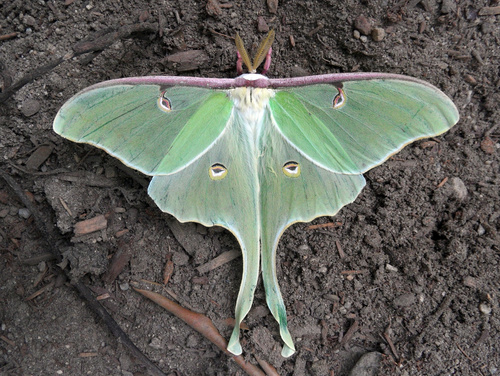
North American Luna Moth
Actias luna
A breathtaking emerald of the night, the Luna Moth is a short-lived wonder of the backyard world. With its long flowing tails and luminous green wings, spotting one is a highlight for any nature enthusiast.
Quick Identification
Size
Wingspan typically ranges from 7.5 to 10.5 cm (3 to 4.5 inches); total length including tails can exceed 12 cm (5 inches).
Colors
Luminous lime-green wings with a reddish-purple or brown leading edge; four distinct circular eyespots with transparent centers; males have large, feathery light-brown antennae.
Key Features
- Distinctive long, tapering tails on the hindwings
- Pale lime-green coloration unlike any other large North American moth
- Four translucent eyespots ringed in yellow, white, and black
- Large, plumose (feathery) antennae used by males to detect pheromones
When You’ll See Them
Behavior
The Luna Moth is one of North America’s most ethereal sights, often described as a 'living emerald.' These giant silk moths have a fascinatingly brief adult life, lasting only about seven to ten days. Because they emerge from their cocoons without functional mouthparts, they do not eat as adults; their entire existence is dedicated to finding a mate and, for females, laying eggs on suitable host plants.
As nocturnal creatures, they spend their days resting motionless on the undersides of leaves or tree trunks where their green color provides excellent camouflage. At night, they take to the air with a somewhat erratic, floppy flight pattern. Males are particularly active fliers, using their sensitive antennae to track the pheromone trails released by females from miles away.
EverydayEarth exclusive
Camera Tips
Capturing a Luna Moth on camera requires a different strategy than mammals because they aren't motivated by food. Instead, they are highly attracted to light. The most effective way to photograph them is to set up a 'moth sheet'—a white bedsheet hung vertically with a UV light or a strong LED shining directly onto it. Place your camera on a tripod facing the sheet. Luna Moths will often land and remain perfectly still for long periods, allowing for incredible macro shots.
If you prefer a more natural setting, position your camera near host trees like Walnut or Sweetgum. Since Luna Moths are erratic fliers, use a fast shutter speed (at least 1/250s) if you hope to catch them in motion, but a slower shutter with a ring flash is ideal for stationary shots to capture the intricate scales on their wings. Set your camera to trigger on motion only if you have a high-quality sensor that can handle low-light conditions without excessive noise.
Placement height should be between 3 to 6 feet off the ground, as they often flutter at this level when searching for mates or host plants. Because they are only active for a few weeks a year, timing is critical. Check local sightings in late spring and early summer, and ensure your camera is ready during the first few hours after total darkness. Avoid using heavy scents or perfumes near the camera, as you don't want to interfere with the pheromone trails the males are trying to follow.
Similar Species
Species that look similar or are commonly confused with North American Luna Moth.
Frequently Asked Questions
Record North American Luna Moth at your habitat
Connect a camera to start building your own species record — AI identifies every visitor automatically.