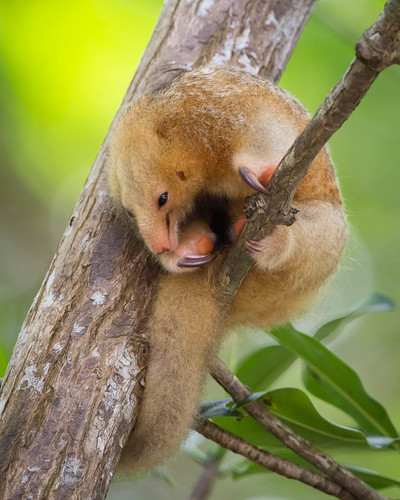
Northeastern Silky Anteater
Cyclopes didactylus
Meet the 'golden ghost' of the canopy—the world's smallest anteater. Shimmering and elusive, the Northeastern Silky Anteater is a nocturnal marvel that spends its life high above the forest floor.
Quick Identification
Size
Total length: 36–45 cm (14–18 in); Weight: 175–400 g (6–14 oz)
Colors
Shimmering golden to yellowish-brown fur with a silky texture; often features a faint dark dorsal stripe and a greyish underside.
Key Features
- Prehensile tail longer than the body
- Two large, curved claws on each front paw
- Small, rounded ears hidden in dense fur
- Distinctive 'defensive' pose with forepaws held near the face
When You’ll See Them
Behavior
The Northeastern Silky Anteater is a master of stealth and high-altitude living. Completely arboreal, it spends its entire life in the canopy, moving with a slow, deliberate pace that makes it nearly invisible to predators. When threatened, it doesn't flee but instead adopts a unique 'boxer' stance, standing on its hind legs and tail while shielding its face with its powerful, clawed forepaws.
These mammals are strictly nocturnal, spending their days curled into tight, golden balls that look remarkably like the seed pods of the silk-cotton (Ceiba) tree. This mimicry is their primary defense against harpy eagles and other raptors. They are solitary creatures, only coming together for brief mating encounters, with the males occasionally helping to carry the young on their backs.
EverydayEarth exclusive
Camera Tips
Capturing the Northeastern Silky Anteater on camera is the ultimate challenge for any backyard or trail cam enthusiast because they never touch the ground. To increase your chances, you must mount your camera high in the canopy. Look for 'wildlife highways'—areas where lianas and vines bridge the gap between large trees. Placing the camera 10 to 20 feet up, angled slightly downward along a thick horizontal branch or a cluster of vines, is the most effective setup.
Since these animals are strictly nocturnal and move slowly, trigger speed is less critical than sensor sensitivity and flash quality. Use a 'No-Glow' or black infrared flash to avoid spooking the animal or overexposing its reflective, silky fur. Set your camera to take 'Bursts' of 3-5 photos or short 15-second videos. Because they move so slowly, a single photo might just look like a clump of moss; video allows you to see the deliberate movement of the tail and claws.
Unlike many mammals, Northeastern Silky Anteaters cannot be lured with traditional baits like food or scent. Instead, focus on their habitat. Use a pole or a climbing kit to position your camera near known ant colonies in Cecropia trees, which are a favorite foraging spot. Ensure the area is clear of small leaves that might trigger the PIR sensor in the wind, as 'false triggers' are the biggest hurdle when filming in the breezy upper canopy.
Similar Species
Species that look similar or are commonly confused with Northeastern Silky Anteater.
Frequently Asked Questions
Record Northeastern Silky Anteater at your habitat
Connect a camera to start building your own species record — AI identifies every visitor automatically.