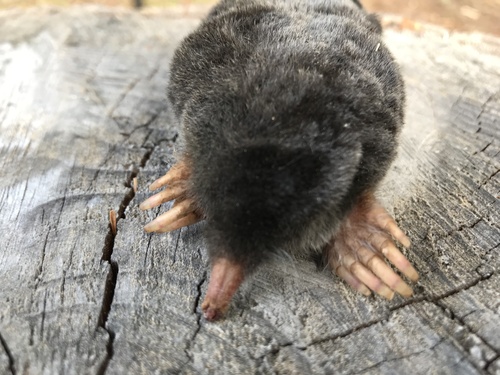
Northern Broad-footed Mole
Scapanus latimanus
The Northern Broad-footed Mole is a subterranean powerhouse, using its specialized spade-like paws to navigate a hidden world beneath your garden. Rarely seen but always working, this master excavator is one of nature's most effective soil aerators.
Quick Identification
Size
Total length 14–19 cm (5.5–7.5 in); weight 50–115 g (1.8–4 oz)
Colors
Uniformly dark brown to grayish-black velvety fur with a silvery sheen; pinkish-gray skin on the snout and paws.
Key Features
- Exceptionally broad, spade-like front paws with stout claws
- Velvety fur that can be brushed in any direction without resistance
- Pointed, hairless snout and nearly invisible eyes and ears
- Stocky, cylindrical body designed for subterranean movement
When You’ll See Them
Behavior
The Northern Broad-footed Mole is a master of the subterranean world, spending nearly its entire life in a complex network of tunnels. It constructs two types of passageways: deep, permanent galleries used for nesting and escaping extreme weather, and shallow surface tunnels used for foraging. These moles are intensely solitary; they defend their tunnel systems vigorously and only seek out others during the brief spring breeding season.
While their presence is often announced by the iconic 'volcano' mounds of soil they push to the surface, they are rarely seen above ground. They have a high metabolism and must hunt almost constantly, using their sensitive snouts to detect vibrations and scents of prey moving through the soil. Despite their reputation as garden pests, they provide a vital service by aerating the earth and consuming large quantities of invasive insect larvae.
EverydayEarth exclusive
Camera Tips
Capturing a Northern Broad-footed Mole on camera is a true test of patience and strategy because they rarely emerge from their tunnels. To increase your chances, look for a 'fresh' surface run—a raised ridge of soil rather than a tall mound. Carefully peel back a 3-inch section of the tunnel roof to expose the passage. Set your camera on a low-profile ground stake or a beanbag, aiming it directly at the opening from a distance of about 12-18 inches. Moles are sensitive to air currents and will usually rush to 'repair' the hole within a few hours, giving you a perfect shot of their snout or paws.
Because moles move with surprising speed when they sense light or danger, use 'Video Mode' or a very high-speed 'Burst Mode.' A camera with a fast trigger speed (under 0.3 seconds) is essential. If your camera allows for focal adjustment, set it to the closest possible range, as these animals are small and will appear as a blurry smudge if the focus is set for larger mammals like deer or foxes.
Standard white-light flashes will likely startle the mole and prevent it from returning to that area. Use an 'Invisible' or 'No-Glow' 940nm infrared flash to ensure the mole remains undisturbed. If you are struggling to find a surface run, try placing a camera near a ground-level water source or a damp patch of soil under a leaky garden hose at night; they occasionally venture out to drink or find new territory during the first rains of autumn.
Be mindful of the weather. The best time to deploy your camera is immediately following a light rain. The moisture brings earthworms to the surface, which in turn brings the moles into their shallowest tunnels where they are easiest to film. Avoid placing cameras in dry, hard-packed clay, as the moles will stay deep underground where your camera can't reach them.
Similar Species
Species that look similar or are commonly confused with Northern Broad-footed Mole.
Frequently Asked Questions
Record Northern Broad-footed Mole at your habitat
Connect a camera to start building your own species record — AI identifies every visitor automatically.