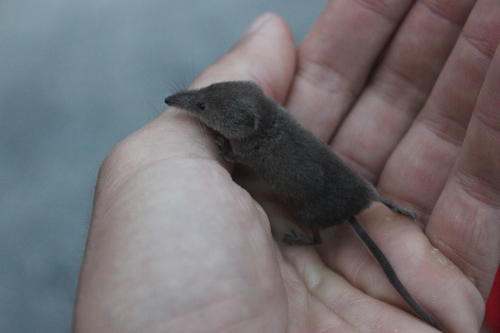
Northern Montane Shrew
Sorex obscurus
A tiny, high-metabolism hunter of the mountain undergrowth, the Northern Montane Shrew is a master of the hidden world beneath the moss.
Quick Identification
Size
Total length 100-140 mm (3.9-5.5 in); Weight 5-10 g (0.18-0.35 oz)
Colors
Dusky brown to grayish-black dorsal fur; pale smoky-gray or silvery underparts; tail is distinctly bicolor, darker on top.
Key Features
- Pointed, mobile snout with prominent whiskers
- Tail length accounts for more than 40% of total body length
- Tiny, bead-like eyes and ears almost entirely concealed by fur
- Velvety fur that lacks a specific 'grain' to allow backward movement in tunnels
When You’ll See Them
Geographic range
Where Does the Northern Montane Shrew Live?
Native to the rugged landscapes of North America, the Northern Montane Shrew is primarily a resident of the western half of the continent. Its range stretches from the boreal forests of Alaska and northern Canada down through the majestic Rocky Mountain corridor and the Pacific coastal ranges of the United States. These tiny survivors are most prevalent in high-latitude or high-altitude environments where moisture levels remain high throughout the year.
Basemap © OpenStreetMap contributors
Behavior
The Northern Montane Shrew is a creature of perpetual motion, driven by an incredibly high metabolic rate that requires it to consume nearly its own body weight in food every day. Because of this, it does not hibernate and remains active throughout the year, even tunneling through the subnivean space beneath deep winter snowpacks to find dormant insects. They are solitary and highly territorial, often engaging in high-pitched squeaking matches if they encounter another shrew.
These mammals are polyphasic, meaning they alternate between short bursts of intense foraging and brief periods of sleep throughout a 24-hour cycle. They are rarely seen in the open, preferring to stick to the 'shrew-highways'—narrow runways hidden under leaf litter, fallen logs, or dense moss. While they are not particularly social with humans, their presence is a sign of a healthy, moist ecosystem with a robust invertebrate population.
EverydayEarth exclusive
Camera Tips
Capturing the Northern Montane Shrew on camera is a rewarding challenge due to their diminutive size and lightning-fast movements. Standard trail camera setups often fail because the animal is too small to trigger the PIR sensor or passes through the frame too quickly. To succeed, place your camera as low as possible, ideally at ground level, and use a 'macro' lens adapter or a camera with a short focal distance to ensure the shrew is in focus.
Baiting is highly effective for keeping a shrew in the frame long enough for a clear shot. A small amount of wet cat food, sardines, or mealworms placed inside a hollow log or under a propped-up piece of bark will encourage the shrew to pause. Focus your camera on the bait station from a distance of about 12 to 18 inches. Using video mode rather than photo mode is highly recommended, as their movements are often too erratic for a single still frame to capture clearly.
Look for natural 'funnels' to place your camera, such as the gap where a fallen log meets a rock or a clear tunnel through thick moss. These are the highways shrews use to stay protected from owls and hawks. Since they are active day and night, ensure your camera has a high-quality infrared flash that won't overexpose small subjects at close range. Reducing the flash intensity in settings can help prevent 'white-out' on their reflective fur.
Similar Species
Species that look similar or are commonly confused with Northern Montane Shrew.
Frequently Asked Questions
Record Northern Montane Shrew at your habitat
Connect a camera to start building your own species record — AI identifies every visitor automatically.