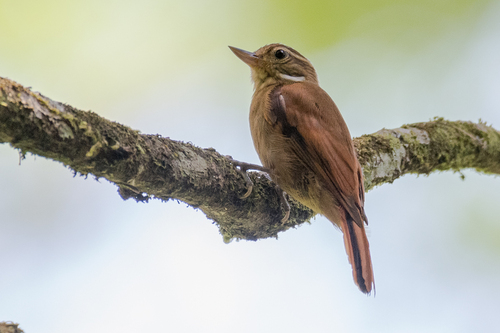
Northern Plain-Xenops
Xenops mexicanus
Meet the forest's tiny acrobat, a bird that spends its life prying secrets from the bark of tropical vines. With its unique upturned bill and gravity-defying moves, the Northern Plain-Xenops is a true marvel of the understory.
Quick Identification
Size
Length: 11.5–12.5 cm (4.5–5 in); Weight: 10–13 g (0.35–0.45 oz)
Colors
Olive-brown upperparts with a pale buffy throat; features a distinct white malar (cheek) stripe and a pale streak above the eye.
Key Features
- Upturned wedge-shaped bill
- Distinctive white 'whisker' stripe on the cheek
- Acrobatic foraging, often upside down
- Uniformly brown underparts with minimal streaking
When You’ll See Them
Geographic range
Where Does the Northern Plain-Xenops Live?
The Northern Plain-Xenops is a native of the Neotropical realm, spanning from southern Mexico through Central America into the northern reaches of South America. Its core range includes the lush forests of Belize, Costa Rica, and Panama, extending into northwestern Venezuela, Colombia, and down the western slopes of the Andes into Ecuador and Peru. This species is a non-migratory resident of the humid tropics, preferring undisturbed or old-growth forest corridors.
Basemap © OpenStreetMap contributors
Behavior
The Northern Plain-Xenops is a high-energy acrobat of the tropical understory. Unlike many other members of the ovenbird family that creep up trunks, the Xenops is famous for its ability to cling to the underside of thin twigs and vines, often hanging completely upside down. It moves with a frantic, jerky motion, constantly inspecting dead wood and curled leaves for hidden treats. It is a solitary bird but frequently joins mixed-species foraging flocks, following woodcreepers and tanagers through the forest.
These birds are remarkably industrious, using their specialized upturned bills to hammer and pry into soft, decaying wood. They even excavate their own nesting holes in rotting branches, a feat that requires significant effort for such a small creature. While they are not particularly shy, their small size and preference for dense foliage make them a delightful challenge for birdwatchers to track as they zip through the shadows.
EverydayEarth exclusive
Camera Tips
To capture a Northern Plain-Xenops on an AI-powered camera, placement is everything. These birds rarely descend to the forest floor, so avoid ground-level mounting. Instead, look for 'hotspots' in the mid-story—specifically areas with a high density of hanging dead vines or thin, rotting branches about 2 to 4 meters off the ground. If you can safely secure your camera to a tree trunk at eye level and angle it toward a nearby vine tangle, you increase your chances of catching their unique foraging behavior.
Because the Northern Plain-Xenops moves quickly and erratically, traditional 'motion' triggers can sometimes be too slow. If your camera settings allow, use a high-speed trigger mode or set the camera to take 3-5 shot bursts. Video mode is particularly effective for this species; seeing the way they use their upturned bill to 'wedge' into wood is a key identification feature that static photos might miss. Ensure your shutter speed is high to avoid motion blur in the dim forest light.
While they don't visit seed feeders, you can attract them to a specific spot by providing a water source in an elevated position. A small, solar-powered birdbath with moving water placed near a forest edge can be a magnet for Xenops looking for a midday drink or bath. In more arid patches of their range, the sound of dripping water is almost irresistible to them and will keep them in the camera's frame for longer periods.
Similar Species
Species that look similar or are commonly confused with Northern Plain-Xenops.
Frequently Asked Questions
Record Northern Plain-Xenops at your habitat
Connect a camera to start building your own species record — AI identifies every visitor automatically.