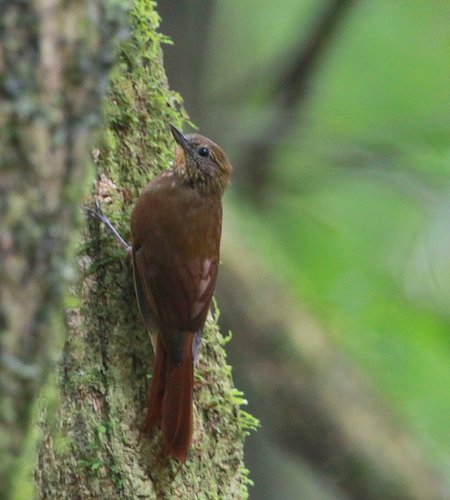
Wedge-billed Woodcreeper
Glyphorynchus spirurus
A tiny, bark-climbing marvel of the tropical rainforest, the Wedge-billed Woodcreeper is easily identified by its unique upturned bill and nuthatch-like agility. This resident of the Neotropics is a master of the vertical world, spending its days hitching up trunks in search of hidden prey.
Quick Identification
Size
Length: 14–15 cm (5.5–6 in); Weight: 12–16 g (0.4–0.6 oz)
Colors
Deep brown upperparts with rufous wings and tail; the throat is buffy-white, and the breast features distinct wedge-shaped buffy spots.
Key Features
- Smallest woodcreeper with a unique short, wedge-shaped bill
- Upturned lower mandible profile
- Stiff-pointed tail feathers used as a prop
- Prominent buffy throat patch
When You’ll See Them
Geographic range
Where Does the Wedge-billed Woodcreeper Live?
The Wedge-billed Woodcreeper is a widespread native of the Neotropics, stretching from southern Mexico across Central America and deep into the South American continent. Its core range encompasses the vast Amazon Basin, including high population densities in Brazil, Peru, and Colombia, and extending to the Guianas and northern Bolivia. This species is a lowland specialist, thriving in the warm, humid environments found from sea level up through the forested foothills of the Andes.
Basemap © OpenStreetMap contributors
Behavior
The Wedge-billed Woodcreeper is a remarkably active and agile bird, often described as the nuthatch of the woodcreeper family. Unlike its larger relatives that often stay on the main trunk, this species frequently explores smaller branches and the undersides of limbs, hitching upward in quick, jerky movements. It is largely solitary or found in pairs, though it frequently joins mixed-species foraging flocks as they move through the understory and mid-story of the forest.
In its interactions with the environment, this bird is a focused specialist. It uses its stiff tail to brace itself against bark while its specialized bill pries into crevices. While not overtly shy around humans, its cryptic coloration and preference for the shaded forest interior make it a challenge to spot without the help of a motion-activated camera. It is a resident species, meaning it defends its territory year-round rather than migrating.
EverydayEarth exclusive
Camera Tips
To successfully capture the Wedge-billed Woodcreeper on camera, you must think vertically. Because this species spends nearly its entire life hitching up tree trunks, standard ground-level trail cameras will miss them entirely. Mount your camera directly onto a tree trunk at a height of 4 to 6 feet. Choose a tree with textured or 'shaggy' bark, as these are preferred foraging sites for the woodcreeper to find hidden insects. Angle the camera slightly upward to capture the bird's approach from below.
While they don't visit traditional bird feeders, you can 'bait' an area by maintaining a natural habitat. If you have a backyard that borders a wooded area, leave dead wood or snags standing. These act as natural magnets for woodcreepers. Another highly effective strategy is to place a camera near a tree-mounted water dripper. In the humid tropics, a consistent source of clean, moving water on a vertical surface is an irresistible lure for a quick bath or drink.
For camera settings, speed is your best friend. Woodcreepers move in sudden, explosive hitches. Set your camera to a fast trigger speed and use a multi-shot burst mode (3-5 photos per trigger). This increases the likelihood of getting a clear shot of the head and that distinctive wedge-shaped bill. Since the forest understory can be quite dark, ensure your camera handles low light well without excessive grain, as most activity happens in the soft light of the early morning.
Similar Species
Species that look similar or are commonly confused with Wedge-billed Woodcreeper.
Frequently Asked Questions
Record Wedge-billed Woodcreeper at your habitat
Connect a camera to start building your own species record — AI identifies every visitor automatically.