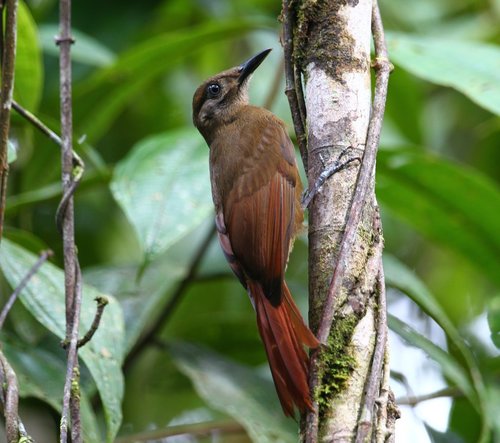
Plain-brown Woodcreeper
Dendrocincla fuliginosa
A master of the vertical world, the Plain-brown Woodcreeper is a subtle beauty of the tropical understory. Watch as this agile trunk-climber follows army ant swarms, skillfully snatching up prey in the shadows of the rainforest.
Quick Identification
Size
19–21 cm (7.5–8.3 in); Weight: 35–50 g (1.2–1.8 oz)
Colors
Uniformly warm olive-brown body with a slightly paler, buff-colored throat; dark bill and gray legs.
Key Features
- Uniformly brown plumage without noticeable streaks or spots
- Stiff, spiny tail feathers used for propping against tree trunks
- Straight, stout dark bill
- Pale buffy-white throat contrasting slightly with the breast
When You’ll See Them
Geographic range
Where Does the Plain-brown Woodcreeper Live?
Native to the tropical regions of Central and South America, the Plain-brown Woodcreeper maintains a massive range extending from Honduras down through the Amazon Basin to central Brazil. It is also a resident of the Caribbean islands of Trinidad and Tobago. While it thrives in the dense, humid interiors of mainland rainforests, it is adaptable enough to persist in older, well-shaded secondary growth throughout its territory.
Basemap © OpenStreetMap contributors
Behavior
In social settings, they can be quite aggressive at ant swarms, often outcompeting smaller birds for the best perches. When not following ants, they are often seen in mixed-species foraging flocks, though they maintain a somewhat shy demeanor around humans. They communicate with a series of descending, whinnying notes that echo through the forest understory.
EverydayEarth exclusive
Camera Tips
Since these birds prefer the dimly lit understory, ensure your camera has a high-quality sensor capable of handling low-light conditions without excessive grain. Use a fast trigger speed; woodcreepers move in quick, jerky bursts and can easily become a blur if the shutter isn't fast enough. If your camera has a 'burst' or 'multi-shot' mode, enable it to catch the specific moment they probe into a crevice or leap to a new trunk.
Baiting woodcreepers is difficult as they are strictly insectivorous and rarely visit traditional bird feeders. However, maintaining a 'wild' corner of a property with rotting logs and leaf litter can attract the insects and ants they follow. In suburban edge environments, setting up a camera near a water drip or a very shallow, shaded birdbath might entice them down for a drink or a quick bath during the hottest part of the afternoon.
Similar Species
Species that look similar or are commonly confused with Plain-brown Woodcreeper.
Frequently Asked Questions
Record Plain-brown Woodcreeper at your habitat
Connect a camera to start building your own species record — AI identifies every visitor automatically.