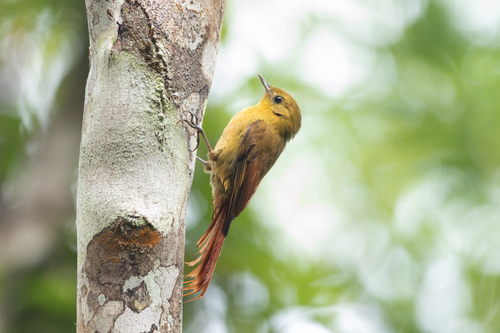
Olivaceous Woodcreeper
Sittasomus griseicapillus
The ultimate tree-climber of the tropics, the Olivaceous Woodcreeper is a master of the vertical world. With its signature spiraling ascent and vibrant cinnamon wings, it brings a touch of wild jungle energy to backyards across the Americas.
Quick Identification
Size
13–19 cm (5.1–7.5 in) long; weighs between 8–20g (0.28–0.71 oz)
Colors
Head, neck, and underparts are plain olive-grey; wings, rump, and tail are a contrasting bright rufous-cinnamon; bill is dark grey
Key Features
- Small, straight, dagger-like bill
- Uniform olive-grey head and breast with no streaks or spots
- Bright cinnamon-red wings and tail
- Stiff, spiny-tipped tail feathers used for support
- Spiraling climbing movement on tree trunks
When You’ll See Them
Geographic range
Where Does the Olivaceous Woodcreeper Live?
This adaptable species is native to the vast Neotropical realm, spanning from central Mexico through every country in Central America. Its core range covers the majority of South America, including the Amazon basin and reaching as far south as northern Argentina and Uruguay, though it avoids the high altitudes of the Andes and the arid coasts of Chile. It is also found on the Caribbean island of Tobago, making it one of the most widely distributed passerines in the Western Hemisphere.
Basemap © OpenStreetMap contributors
Behavior
The Olivaceous Woodcreeper is a master of vertical movement, spending nearly all its waking hours hitching its way up tree trunks. It moves in a characteristic spiraling pattern, starting near the base of a tree and working its way upward before flying down to the base of a neighboring tree to begin the process again. This behavior is supported by specialized, stiffened tail feathers that act as a tripod leg against the bark.
Unlike many other woodcreepers that are shy forest interior specialists, the Olivaceous Woodcreeper is remarkably adaptable. It is frequently the most common woodcreeper found near human settlements, provided there are enough mature trees to support its foraging. It is a highly social 'follower,' often serving as a nuclear member of mixed-species foraging flocks, traveling alongside tanagers, antshrikes, and warblers through the canopy.
EverydayEarth exclusive
Camera Tips
To capture the Olivaceous Woodcreeper on an AI camera, you must think vertically. These birds rarely land on the ground, so a traditional feeder-style setup won't work. Mount your camera directly onto the trunk of a large, rough-barked tree at a height of about 4 to 6 feet (1.2 to 1.8 meters). Aim the lens slightly upward to catch them as they hitch their way past the sensor. Because they are small and fast-moving, use a high-speed trigger setting and burst mode to ensure you don't just get a blur of rufous wings.
While they don't visit seed feeders, they are highly attracted to water. A tree-mounted birdbath or a simple dripper system that splashes against the bark or a high basin can be a magnet for them. They often visit these water sources during the hottest part of the early afternoon. Position your camera to face a mossy branch or a section of the trunk near the water source for the best composition.
Lighting is key for identification, as their olive-grey body can blend into the shadows of the forest. Try to place your camera on a tree that receives mottled morning sunlight. This will help the AI distinguish the bird's plain grey throat from other similar-looking streaked woodcreepers. If you are using a trail camera, look for 'cleaning' behavior where they pause to preen after a bath; these are the best moments for high-quality, still images.
Similar Species
Species that look similar or are commonly confused with Olivaceous Woodcreeper.
Frequently Asked Questions
Record Olivaceous Woodcreeper at your habitat
Connect a camera to start building your own species record — AI identifies every visitor automatically.