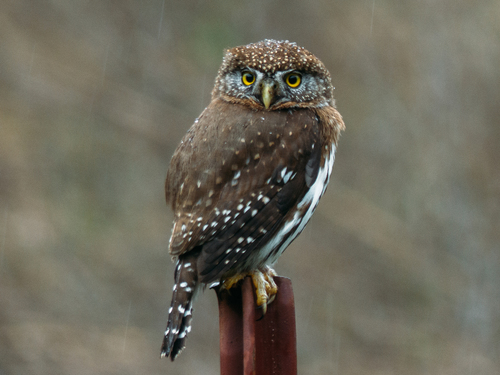
Northern Pygmy-Owl
Glaucidium gnoma
Don't let the small size fool you—the Northern Pygmy-Owl is one of the most ferocious and active hunters in the forest. Identifiable by the 'eyes' on the back of its head, this tiny titan is a favorite for backyard birdwatchers and trail cam enthusiasts alike.
Quick Identification
Size
Length: 6-7 inches (15-17 cm) | Wingspan: 12-15 inches (30-38 cm) | Weight: 2.1-2.6 oz (60-75 g)
Colors
Typically grayish-brown or rufous with fine white spotting on the crown; white underparts with heavy dark vertical streaking; two prominent black 'eye spots' on the nape.
Key Features
- Two dark 'false eyes' on the back of the neck
- Relatively long tail often cocked at an upward angle
- Small, circular head without ear tufts and piercing yellow eyes
When You’ll See Them
Behavior
Unlike most of their nocturnal relatives, the Northern Pygmy-Owl is a bold daylight hunter. These pint-sized predators are incredibly fierce, often taking down prey twice their own size. You will frequently see them perched on the very tops of conifers or snagged branches, scanning the ground and air for movement. Their flight is rhythmic and woodpecker-like, consisting of several quick flaps followed by a short glide.
One of their most fascinating social behaviors is their interaction with songbirds. Because they are such effective hunters, smaller birds like chickadees and nuthatches will often 'mob' them, chirping loudly and diving at the owl to drive it away. If you hear a commotion of small birds in your backyard, there is a high probability a Northern Pygmy-Owl is the culprit at the center of the storm.
EverydayEarth exclusive
Camera Tips
To capture the Northern Pygmy-Owl, placement is everything. Unlike larger owls that stick to deep cover, these birds love 'vantage points.' Mount your camera 6 to 10 feet high on a tree trunk, angled toward an open branch or a 'snag' (a dead standing tree). Because they are diurnal, you don't need to worry as much about IR flash distance, but a camera with a fast trigger speed is essential—these owls strike with lightning fast movements that can easily blur on slower sensors.
If you have a bird feeding station, place a camera about 15 feet away facing the nearest evergreen or dense shrubbery. Pygmy-owls are notorious for 'staking out' feeders to hunt the songbirds that visit them. Setting your camera to 'Video Mode' or 'Burst Mode' is highly recommended; this allows you to see their characteristic tail-flicking and the way they swivel their heads to show off their 'false eyes' on the back of their necks, which are meant to deter larger predators from sneaking up on them.
During the winter months, these owls often move to lower elevations and closer to human dwellings in search of food. This is the best time to use a wide-angle trail camera near water features. A heated birdbath can be a major draw for them. While they aren't attracted to traditional bait, the presence of their natural prey—songbirds and small rodents—is the best lure you can have. Ensure your camera is set to its highest resolution to capture the intricate white spotting on their plumage, which provides excellent camouflage against bark.
Similar Species
Species that look similar or are commonly confused with Northern Pygmy-Owl.
Northern Saw-whet Owl
Strictly nocturnal with a larger, heart-shaped facial disc and no 'false eyes' on the back of the neck.
Ferruginous Pygmy-Owl
Found only in the extreme Southwest; has a more streaked crown rather than the white spots found on the Northern Pygmy-Owl.
Elf Owl
Even smaller (sparrow-sized) and strictly nocturnal, lacking the long tail and fierce diurnal hunting habits.
Frequently Asked Questions
Record Northern Pygmy-Owl at your habitat
Connect a camera to start building your own species record — AI identifies every visitor automatically.