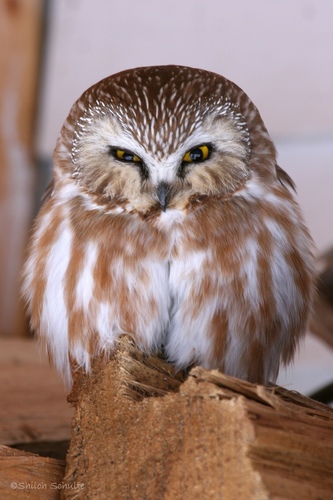
Northern Saw-whet Owl
Aegolius acadicus
The tiny titan of the forest, the Northern Saw-whet Owl is a master of camouflage and a favorite among backyard birders. Despite their small stature, these fierce hunters are surprisingly approachable and make for stunning captures on your backyard wildlife camera.
Quick Identification
Size
Length: 17-21 cm (6.7-8.3 in) | Wingspan: 42-48 cm (16.5-18.9 in) | Weight: 65-151 g (2.3-5.3 oz)
Colors
Rich reddish-brown upperparts with white spotting; white underparts with broad reddish-brown vertical streaks. Facial disk is pale brownish-white with a distinct white 'V' between the eyes. No ear tufts.
Key Features
- Tiny, cat-sized frame with a large, rounded head
- Prominent white 'V' shape on the facial disk
- Bright yellow irises and a dark beak
- Lack of ear tufts and heavily feathered feet
When You’ll See Them
Behavior
Northern Saw-whet Owls are famously 'tame' or approachable, though this is actually a defense mechanism. They rely so heavily on their camouflage that they will remain perfectly still even when a human is only a few feet away. In the wild, they spend their days perched in the densest part of evergreen thickets, often at eye level, to avoid being spotted by larger hawks or Great Horned Owls who would gladly make a meal of them.
These owls are solitary and highly nocturnal, only becoming active after complete darkness has fallen. While they are migratory, their movements are somewhat unpredictable and 'irruptive,' meaning some years they appear in large numbers in southern latitudes while other years they stay further north. During the breeding season, males are vocal, giving a repetitive, mechanical 'toot' call that can last for hours.
EverydayEarth exclusive
Camera Tips
Because Northern Saw-whet Owls are incredibly small and stay low to the ground, your camera placement needs to be lower than it would be for a Great Horned or Barred Owl. Look for 'whitewash' (white droppings) or small pellets (undigested fur and bones) at the base of dense evergreens like spruce, cedar, or yew. Position your camera about 3 to 5 feet off the ground, angled toward the interior of the tree's branches. These owls often return to the exact same 'roost' branch every day, so once you find a spot, keep your camera there.
Since these birds are strictly nocturnal, ensure your camera has a high-quality infrared (IR) flash. Standard white flashes will likely startle the owl and cause it to abandon the roost. Set your trigger sensitivity to 'High' because a 3-ounce bird may not always trigger a PIR sensor designed for deer or larger mammals. A 'Burst Mode' of 3-5 photos is ideal to catch the moment they land or take off, which happens in the blink of an eye.
If you have a birdbath, keep it running with a heater during the winter. Saw-whets need to drink and bathe even in freezing temperatures, and a water source in an otherwise frozen landscape is one of the best ways to lure them into the open for a clear shot. Avoid using recorded calls to attract them, as this can cause them unnecessary stress and draw the attention of larger predators to their hiding spot.
During the late fall and winter months, focus your efforts on the edges of your property where forest meets open yard. They love the cover of ornamental landscaping but need the nearby open space to hunt for mice. If you have a woodpile or a compost heap that attracts rodents, aim a camera at a nearby low-hanging branch; this is likely where the owl will sit while scanning for a midnight snack.
Similar Species
Species that look similar or are commonly confused with Northern Saw-whet Owl.
Boreal Owl
The Boreal Owl is slightly larger with a light-colored bill and black borders on its facial disk, whereas the Saw-whet has a dark bill and no black border.
Eastern Screech-Owl
Screech-owls have prominent ear tufts and vertical 'bark-like' patterning, while Saw-whets have rounded heads and blurry reddish-brown streaking.
Northern Pygmy-Owl
Pygmy-owls are diurnal (active in daytime) and have two black 'eye spots' on the back of their heads which Saw-whets lack.
Frequently Asked Questions
Record Northern Saw-whet Owl at your habitat
Connect a camera to start building your own species record — AI identifies every visitor automatically.