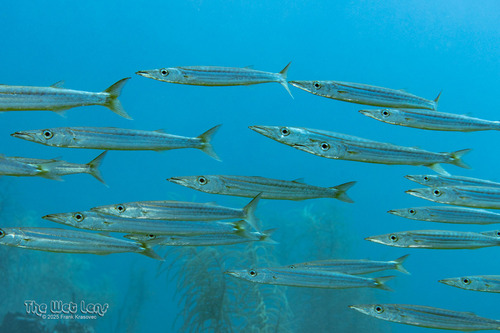
Northern Sennet
Sphyraena borealis
The Northern Sennet is a sleek, silver arrow of the Atlantic coast, bringing the thrill of the barracuda family to shallow bays and backyard docks. A master of the high-speed ambush, this fascinating predator is a favorite for underwater observers.
Quick Identification
Size
Typically 10-18 inches (25-45 cm) in length; weighs up to 1 lb (0.45 kg).
Colors
Silvery-white belly and sides with a dark olive to brownish-green back; subtle dark blotches along the lateral line.
Key Features
- Slender, torpedo-shaped body
- Protruding lower jaw with visible sharp teeth
- Two widely separated dorsal fins
- Large, dark eyes positioned near the top of the head
When You’ll See Them
Behavior
The Northern Sennet is the smaller, more refined cousin of the infamous Great Barracuda. Unlike their solitary larger relatives, Sennets are highly social during their juvenile stages, often forming tight-knit schools that shimmer in the light of coastal estuaries and shallow bays. They are high-speed ambush predators, using their streamlined bodies to launch lightning-fast strikes at passing prey. Despite their intimidating dental equipment, they are shy around humans and pose no threat to swimmers.
As they mature, they tend to move into deeper shelf waters, but they are frequently seen by coastal residents patrolling the shadows of docks and piers. They are masters of the 'sit and wait' strategy, often hovering nearly motionless in the water column, blending into the silvery reflections of the surface before darting forward with a burst of speed that is difficult for the human eye to track.
EverydayEarth exclusive
Camera Tips
To capture the Northern Sennet on camera, you will need to transition from a traditional trail cam to an underwater setup or a dock-mounted waterproof camera. The best location for placement is on the shaded side of a dock piling or bridge abutment about 2 to 4 feet below the low-tide line. Sennets love to hang out in the 'shadow line' where the structure meets the open water, waiting to ambush small baitfish that are attracted to the dock's algae growth.
Because these fish are incredibly fast, set your camera to its highest possible frame rate (at least 60fps) to avoid motion blur during a strike. If your camera supports a 'pre-roll' or high-speed trigger, enable it. Position the lens horizontally across the face of the piling rather than pointing out into the open blue; this uses the structure as a backdrop, making it easier for the AI to maintain focus on the fish's silvery scales against the dark wood or concrete.
While they are diurnal hunters, you can improve your capture rate by using a small submersible LED light at night to attract baitfish. While the Sennet might not hunt actively in total darkness, they will often be found lurking just at the edge of the light's reach at the first crack of dawn, ready to feast on the concentrated schools of minnows. Ensure your housing is cleaned weekly, as saltwater biofouling can obscure the lens very quickly in the warm summer months when Sennets are most active.
Similar Species
Species that look similar or are commonly confused with Northern Sennet.
Great Barracuda
Much larger (up to 5 feet) with dark ink-like spots on the lower silver sides.
Guachanche Barracuda
Features a distinct dusky margin on the tail fin and generally inhabits deeper muddy bottoms compared to the Sennet.
Atlantic Needlefish
Thinner, more eel-like body with much longer, thinner jaws that both taper to a point.
Frequently Asked Questions
Record Northern Sennet at your habitat
Connect a camera to start building your own species record — AI identifies every visitor automatically.