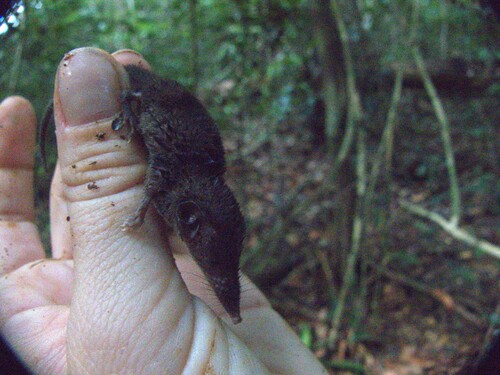
obscure white-toothed shrew
Crocidura obscurior
The obscure white-toothed shrew is a miniature marvel of the West African rainforest. Often hidden beneath the leaf litter, this tiny hunter is a testament to the incredible biodiversity found on the forest floor.
Quick Identification
Size
Length 4.5–6 cm (1.8–2.4 in), tail 3–4.5 cm (1.2–1.8 in), weight 3–5 grams (0.1–0.2 oz)
Colors
Uniform dark chocolate brown to grayish-black upperparts, slightly lighter gray-brown underparts, flesh-colored ears.
Key Features
- Tiny, mouse-like appearance with an exceptionally long snout
- Prominent ears visible above short, velvety fur
- Short tail with scattered long sensory hairs (vibrissae)
- Pure white teeth, lacking the iron-staining found in other shrew families
When You’ll See Them
Geographic range
Where Does the obscure white-toothed shrew Live?
This species is a native specialist of the Upper Guinean forest block in West Africa. Its core range spans the lush, tropical landscapes of Ivory Coast, Ghana, Guinea, Liberia, and Sierra Leone. It is strictly tied to moist lowland environments and does not currently have any known introduced populations outside of its native African tropical belt.
Basemap © OpenStreetMap contributors
Behavior
While primarily solitary, these shrews are known for their territorial nature despite their diminutive size. They are rarely seen by humans due to their preference for dense cover and their lightning-fast movements. When threatened or navigating, they may emit high-pitched squeaks, some of which border on ultrasonic, helping them communicate or orient themselves in the complex architecture of the forest floor.
EverydayEarth exclusive
Camera Tips
To capture the obscure white-toothed shrew on camera, you must think small. These mammals are tiny and stay low to the ground, so place your camera at an ultra-low angle—no more than 5 to 10 centimeters off the soil. Instead of aiming across a wide clearing, point the lens along 'natural runways' like the edge of a fallen log or a tunnel through thick leaf litter where shrews feel safest from owls and snakes.
Standard PIR sensors can sometimes miss such a small heat signature. To ensure a trigger, set your camera to its highest sensitivity and use a 'Fast' or 'Instant' trigger speed setting. If your camera supports a 'Macro' mode or has a close focal range, use it; otherwise, the shrew may appear as a blurry brown speck. Using a burst mode of 3-5 photos per trigger is essential, as these animals move with jerky, rapid motions that can easily result in an empty frame if the shutter is too slow.
Luring is highly effective for this species. A small amount of pungent bait, such as wet cat food or minced meat, placed inside a small cage or under a perforated log, will encourage the shrew to linger and sniff around. This 'dwell time' is your best chance for a high-quality image. Since they are active both day and night but prefer the cover of darkness, ensure your infrared flash is functioning well for clear black-and-white night shots.
Similar Species
Species that look similar or are commonly confused with obscure white-toothed shrew.
Frequently Asked Questions
Record obscure white-toothed shrew at your habitat
Connect a camera to start building your own species record — AI identifies every visitor automatically.