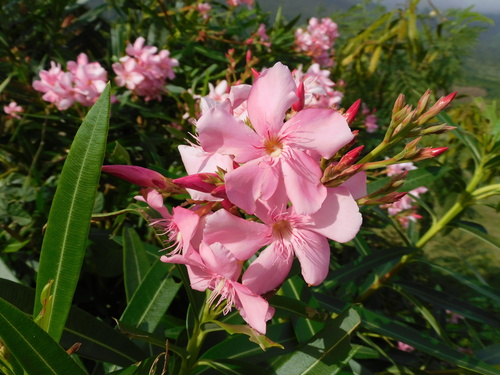
oleander
Nerium oleander
A Mediterranean icon of beauty and resilience, the Oleander defines summer with its lush evergreen leaves and vibrant, honey-scented blooms. Though famous for its toxicity, it remains a favorite for gardeners seeking a hardy, drought-tolerant screen that thrives under the hottest sun.
Quick Identification
Size
Height: 2–6 m (6.5–20 ft); Spread: 1.8–3 m (6–10 ft)
Colors
Leathery dark green foliage; flowers range from pure white and pale yellow to deep pink and vibrant red
Key Features
- Narrow, lance-shaped leaves arranged in pairs or whorls of three
- Clusters of funnel-shaped flowers with five petals
- Produces long, narrow seed pods that split to release fuzzy seeds
- Thick, milky sap visible when stems are broken
When You’ll See Them
Behavior
Oleander is a robust, evergreen shrub known for its incredible resilience and rapid growth rate. In the backyard landscape, it often serves as a living privacy screen or windbreak due to its dense branching habit. While it is celebrated for its prolonged blooming season, it is most famous for its chemical defense system; the plant contains cardiac glycosides, making every part of it—from the roots to the nectar—highly toxic to humans and most animals if ingested.
Despite its toxicity, oleander plays a unique role in the local ecosystem. It is a host plant for the spectacular Oleander Hawk-moth and provides nesting cover for various bird species that are immune to its toxins or simply utilize its dense structure for protection. In suburban environments, it is often seen as a 'set it and forget it' plant because it thrives in poor soil, intense heat, and periods of drought where other ornamentals might wither.
EverydayEarth exclusive
Camera Tips
To capture the true beauty of oleander on your backyard camera, focus on time-lapse photography during the peak blooming months of late spring and summer. Set your camera on a sturdy tripod or mount it to a nearby fence post, angling it slightly downward to capture the clusters of terminal flowers. Because oleander stems can sway significantly in the wind, use a faster shutter speed (1/250 or higher) if your camera settings allow, or choose a calm morning for the clearest shots. This will ensure the delicate details of the petals and the narrow leaves remain sharp.
If you are interested in the wildlife that visits oleander, position your camera for macro or close-up shots near the flower clusters. While many mammals avoid the plant, it is a magnet for specific insects. Night-vision or infrared settings are essential if you hope to catch the Oleander Hawk-moth, which is most active at dusk and during the night. Place the camera about 2 to 3 feet from a particularly flower-heavy branch to capture these rapid-fliers as they hover to feed on nectar.
For those using AI-powered cameras like the ones featured on EverydayEarth, oleander makes an excellent permanent 'station' for bird activity. Birds like house finches and scrub jays often use the inner branches for cover. Position your camera at a height of 4 to 5 feet, pointed toward a natural opening in the foliage. Avoid using food-based lures directly on the plant to prevent accidental ingestion of the toxic sap by non-target species; instead, rely on the natural architecture of the shrub to provide the 'stage' for your wildlife captures.
Similar Species
Species that look similar or are commonly confused with oleander.
Desert Willow
Has ruffled, orchid-like flowers and is deciduous, losing its leaves in winter unlike the evergreen oleander.
Mountain Laurel
Features cup-shaped flowers with distinct purple markings and broader, oval-shaped leaves.
Yellow Oleander
Belongs to a different genus (Cascabela) and features narrower, more linear leaves and distinctly bell-shaped yellow flowers.
Frequently Asked Questions
Record oleander at your habitat
Connect a camera to start building your own species record — AI identifies every visitor automatically.