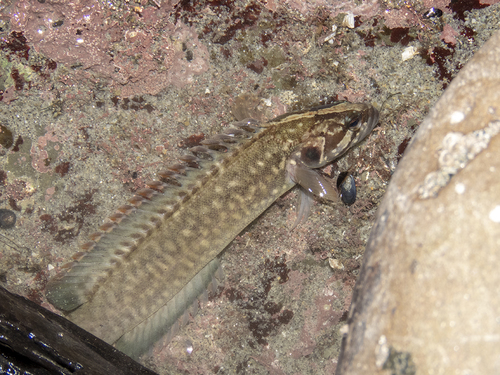
Olive Rockfish
Acanthoclinus fuscus
A master of the New Zealand shoreline, the Olive Rockfish is an eel-like survivor that can breathe air and guard its home with fierce loyalty. Spot its iconic white headband as it navigates the rugged intertidal world.
Quick Identification
Size
Grows up to 30 cm (12 inches) in length
Colors
Deep black to dark olive-brown body with a prominent, narrow white band or stripe across the top of the head behind the eyes
Key Features
- Eel-like elongated body
- Distinctive white vertical band on the head
- Continuous long dorsal and anal fins
- Sinuous, snake-like swimming motion
When You’ll See Them
Behavior
The Olive Rockfish is a remarkably hardy inhabitant of New Zealand’s rugged coastline. Unlike many fish that retreat with the receding tide, these resilient creatures are permanent residents of the intertidal zone. They exhibit a fascinating 'homing' behavior, where individuals claim specific rock pools as their territory and will return to the same spot even if displaced. When the tide goes out, they hunker down in crevices or under large boulders, waiting for the water to return.
One of their most unique adaptations is the ability to breathe air for short periods, allowing them to survive in oxygen-depleted pools or even move between puddles if their current environment becomes unsuitable. They are generally solitary and can be quite territorial. During the breeding season, the species shows a dedicated side; the males take on the responsibility of guarding the egg clusters until they hatch, protecting them from hungry scavengers that roam the tide pools.
EverydayEarth exclusive
Camera Tips
Capturing the Olive Rockfish requires an underwater-rated camera or a high-quality action camera in a waterproof housing. Since these fish are 'homing' creatures, the secret to success is finding a permanent rock pool with plenty of deep crevices and overhangs. Place your camera at the bottom of a pool during low tide, securing it with a weighted base or a small tripod wedged between heavy stones to prevent it from being swept away by the surging surf as the tide returns.
Angle the lens toward the dark recesses of a rock shelf or the entrance of a small cave, as this is where the Olive Rockfish spends most of its time lurking for prey. Natural lighting is best, so aim for shallow pools where the sun can penetrate the water. If your AI camera supports it, set the motion trigger sensitivity higher to account for the swaying of seaweed, or use a 'record on movement' setting that focuses on the center of the frame where the fish is likely to emerge.
Because the Olive Rockfish is known for its distinctive white head band, try to position the camera at a 45-degree downward angle. This perspective makes it much easier for AI identification software to pick up the high-contrast marking against the fish's dark body. To attract one into the frame, you can try 'chumming' the water slightly with crushed bits of local shellfish, but the best shots usually come from patient observation of their natural hunting paths within the pool.
Lastly, be mindful of the salt environment. Rinse your camera housing thoroughly with fresh water after every session to prevent corrosion. The best footage is often captured just as the tide begins to fill the pool, as the influx of fresh, oxygenated water usually triggers a burst of activity and hunting behavior in these fascinating rock-dwellers.
Similar Species
Species that look similar or are commonly confused with Olive Rockfish.
Frequently Asked Questions
Record Olive Rockfish at your habitat
Connect a camera to start building your own species record — AI identifies every visitor automatically.