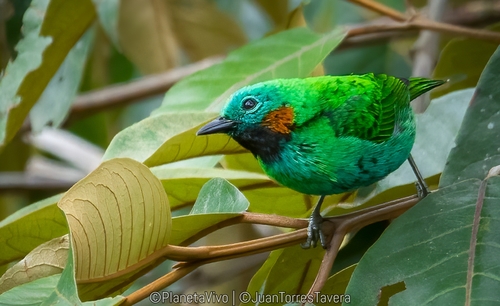
Orange-eared Tanager
Chlorochrysa calliparaea
A shimmering emerald gem of the Andes, the Orange-eared Tanager brings a flash of brilliant color to the misty cloud forests of South America.
Quick Identification
Size
12–13 cm (4.7–5.1 in) long; weighs approximately 17–22 g (0.6–0.8 oz)
Colors
Brilliant emerald green body with shimmering scales; distinctive orange or rufous patch behind the eye; black throat and lore markings; blue highlights on the rump and belly depending on the subspecies.
Key Features
- Vibrant emerald-green iridescent plumage
- Bright orange or rufous-red 'ear' patch behind the eye
- Small black throat patch (bib)
- Stout, slightly curved dark bill
When You’ll See Them
Geographic range
Where Does the Orange-eared Tanager Live?
Native to the lush, mountainous corridors of South America, the Orange-eared Tanager is a quintessential Andean species. Its core range follows the eastern slopes of the Andes, stretching from coastal Venezuela through Colombia, Ecuador, and Peru, reaching its southern limit in the yungas of Bolivia. This bird is a true resident of the 'tierra templada,' favoring the humid, mist-shrouded forests where moss and epiphytes thrive.
Basemap © OpenStreetMap contributors
Behavior
The Orange-eared Tanager is a high-energy acrobat of the canopy, rarely staying still for long. It is most frequently observed as part of fast-moving, mixed-species foraging flocks, traveling alongside other tanagers, flowerpiercers, and woodcreepers. While they spend much of their time high in the trees, they are known to descend to lower levels at forest edges or near clearings where fruiting shrubs are abundant.
These birds exhibit a specialized foraging technique known as 'leaf-turning,' where they acrobatically cling to the undersides of mossy branches and foliage to glean small insects. In social settings, they are non-aggressive but vocal, maintaining contact with their flock through thin, high-pitched 'seep' calls that can be difficult for the human ear to track in the dense mist of the cloud forest.
EverydayEarth exclusive
Camera Tips
To capture the stunning iridescence of the Orange-eared Tanager, lighting is everything. Place your camera in a spot that receives filtered morning light; direct, harsh overhead sun can wash out the subtle greens and blues of their feathers, while too much shade makes them look dark and olive-colored. Position the camera at eye level near a known fruiting tree, particularly those in the Melastomataceae family, as these are irresistible magnets for this species.
Because these birds are small and move rapidly, use a camera with a high-speed trigger and a fast recovery time. If your device allows for 'Burst Mode' or 'Photo+Video' settings, enable them. A single frame often misses the bird as it darts between branches, but a three-shot burst is likely to catch that perfect moment when the orange ear patch is visible against the green foliage.
If you are setting up a camera near a dwelling or eco-lodge, a high-altitude bird bath or a shallow stone basin with dripping water is incredibly effective. Orange-eared Tanagers are meticulous about grooming and will visit reliable water sources daily. Aim the camera at a sturdy, moss-covered perch near the water rather than the water itself to get more natural, 'wild' looking shots of the bird as it prepares to bathe.
Similar Species
Species that look similar or are commonly confused with Orange-eared Tanager.
Glistening-green Tanager
Uniformly bright 'neon' green without the black throat or orange ear patches.
Multicolored Tanager
Has a yellow crown and blue wings, whereas the Orange-eared is predominantly emerald green.
Golden-eared Tanager
Largely black upperparts with heavy spotting and a much brighter yellow (rather than orange) ear patch.
Frequently Asked Questions
Record Orange-eared Tanager at your habitat
Connect a camera to start building your own species record — AI identifies every visitor automatically.