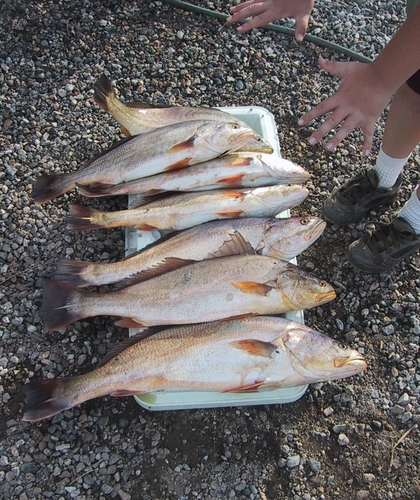
Orangemouth Corvina
Cynoscion xanthulus
A champion of the Gulf's estuaries, the Orangemouth Corvina is a shimmering predator famous for its golden-hued mouth and booming underwater 'songs.'
Quick Identification
Size
Length up to 90 cm (36 inches); weight typically between 4.5–11.3 kg (10–25 lbs)
Colors
Silvery-blue to brassy back with white underbelly; distinctive bright orange lining in the mouth and throat
Key Features
- Bright orange-yellow interior of the mouth
- Two prominent canine-like teeth in the upper jaw
- Silvery body with small dark spots on the dorsal and tail fins
- Streamlined, torpedo-shaped build
When You’ll See Them
Geographic range
Where Does the Orangemouth Corvina Live?
Native to the North American continent, the Orangemouth Corvina primarily inhabits the subtropical waters of the Gulf of California. Its core range extends along the Mexican coastline from the Colorado River Delta down through the Sea of Cortez. While a famous population was introduced to the Salton Sea in the United States, environmental changes have made them increasingly rare in that landlocked region, leaving the coastal estuaries of Sonora and Baja California as their primary strongholds.
Basemap © OpenStreetMap contributors
Behavior
The Orangemouth Corvina is a powerful, schooling predator known for its aggressive hunting style and unique acoustic signatures. As a member of the drum family (Sciaenidae), it uses specialized muscles to vibrate its swim bladder, creating a distinct 'croaking' or 'drumming' sound. This behavior is most prevalent during the spawning season when males use these sounds to attract mates, creating an underwater chorus that can sometimes be heard from the surface.
These fish are highly mobile and exhibit schooling behavior, especially when young. As they mature into apex predators within their local ecosystems, they become more solitary or hunt in smaller, elite groups. They are known to follow the tides, moving into shallow estuaries and lagoons during high tide to feast on abundant prey before retreating to deeper, cooler waters as the tide recedes.
In terms of human interaction, the Orangemouth Corvina is a legendary game fish. While they are wary of loud noises and heavy boat traffic, they are famously bold when feeding, often igniting 'boils' on the water's surface as they drive schools of baitfish upward. This predatory focus makes them a fascinating subject for underwater observation, provided the observer remains quiet and still.
EverydayEarth exclusive
Camera Tips
Capturing the Orangemouth Corvina requires a specialized underwater camera setup, as this species never leaves the water. If you live on a coastal estuary or a saline canal, the best approach is to mount a waterproof camera to a dock piling or a weighted tripod on the seafloor. Position the lens at a depth of 1 to 3 meters, facing toward the current. Corvina often swim against the tide looking for prey swept toward them, so capturing them head-on provides the most dramatic footage of their namesake orange mouths.
Because Corvina are attracted to movement and vibration, you can 'lure' them into the camera's frame using a shiny metal spoon or a slow-moving lure suspended just within the field of view. Do not use actual hooks if your goal is just observation. A scent-slick created by a mesh bag of crushed sardines or shrimp tied near the camera can also encourage these predators to linger and investigate, providing a much higher chance of a clear, close-up identification shot.
Lighting is your biggest challenge in the murky, brackish waters these fish prefer. Use a camera with high dynamic range (HDR) and, if possible, external underwater LEDs positioned 45 degrees away from the lens to minimize backscatter from silt. The best footage is typically captured during the 'golden hours' of dawn and dusk when Corvina move into the shallows to hunt. If using a trail-style underwater camera, ensure it is set to a high frame rate to capture their lightning-fast strikes on baitfish.
Similar Species
Species that look similar or are commonly confused with Orangemouth Corvina.
Frequently Asked Questions
Record Orangemouth Corvina at your habitat
Connect a camera to start building your own species record — AI identifies every visitor automatically.