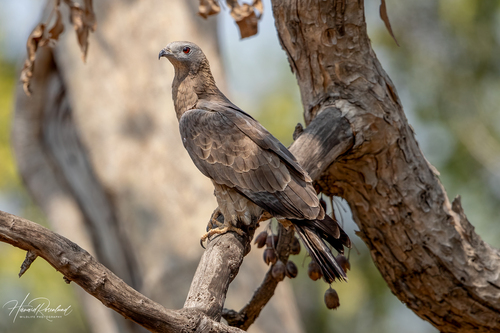
Oriental Honey-buzzard
Pernis ptilorhynchus
Meet the armored specialist of the sky. The Oriental Honey-buzzard is a unique raptor that trades the chase for a tactical raid on wasp nests, sporting specialized feathers designed to withstand a thousand stings.
Quick Identification
Size
Length: 52–68 cm (20–27 in); Wingspan: 115–155 cm (45–61 in); Weight: 750–1500 g (1.6–3.3 lbs)
Colors
Extremely variable plumage ranging from pale cream to dark chocolate brown. Males typically have blue-grey heads and dark irises, while females have browner heads and yellow irises.
Key Features
- Small, pigeon-like head on a long, slender neck
- Broad wings with rounded tips and distinct dark 'fingers'
- Long tail with a wide, dark terminal band
- Unique scale-like feathers between the beak and eyes to prevent insect stings
When You’ll See Them
Behavior
The Oriental Honey-buzzard is a master of patience and tactical foraging. Unlike many raptors that hunt through high-speed aerial chases, this bird is a specialist that spends hours perched quietly in the canopy, watching the flight paths of social bees and wasps. By tracking these insects, it locates their nests, which it then raids using its powerful, curved talons to dig out the nutrient-rich larvae and pupae.
Socially, these birds are generally solitary or found in pairs during the breeding season. However, they are famous for their spectacular migratory gatherings. During the spring and autumn, thousands can be seen 'kettling' together—soaring in circular patterns on warm air currents—as they move between their breeding grounds in northern Asia and their wintering homes in Southeast Asia.
Though they are birds of prey, they are relatively unaggressive toward humans and other birds. They have adapted surprisingly well to human-modified landscapes, provided there are enough tall trees for nesting and a healthy population of stinging insects to sustain their specialized diet.
EverydayEarth exclusive
Camera Tips
To capture the Oriental Honey-buzzard, location is everything. These birds prefer high, unobstructed perches with a wide view of the surrounding landscape. Position your camera 10 to 15 feet up in a mature tree, ideally at the edge of a clearing or overlooking a garden. An angled mount that looks slightly downward can help capture the intricate patterns on their back and wings, which are vital for identifying the specific subspecies and sex.
Since they are 'bee-hunters,' the presence of wasp or hornet nests is a major attractant. If you have a known nest high in your eaves or in a nearby tree, place your camera with a clear line of sight to it from a distance of 20 feet. Do not attempt to lure them with meat or seeds; instead, focus on maintaining a pesticide-free backyard that encourages natural insect activity. A large, shallow birdbath or water feature can also be a significant draw, as these large raptors frequently descend to drink and bathe during the heat of the afternoon.
Technical settings should prioritize trigger speed. While the honey-buzzard may sit still for long periods while scouting, its strike or takeoff is sudden and fast. Use a 'High' sensitivity setting and, if your AI camera allows, specifically enable 'Large Bird' or 'Raptor' detection. Given the high contrast of the sky, try to face your camera north or south to avoid the 'blown-out' effect of the morning or evening sun behind the bird.
For the most compelling footage, use video mode with 20-30 second clips. This allows you to observe their unique foraging behaviors, such as the way they tilt their heads to track insects or how they use their specialized feet to manipulate honeycomb. During peak migration months, check your camera daily, as these birds often follow the same geographical corridors and may use your yard as a consistent pit stop.
Similar Species
Species that look similar or are commonly confused with Oriental Honey-buzzard.
Common Buzzard
Common Buzzards have a much stockier build, a shorter neck, and lacks the specialized scale-like feathers on the face.
European Honey-buzzard
Very similar, but the Oriental species is larger, often has a small crest, and usually shows six primary 'fingers' on the wingtips instead of five.
Frequently Asked Questions
Record Oriental Honey-buzzard at your habitat
Connect a camera to start building your own species record — AI identifies every visitor automatically.