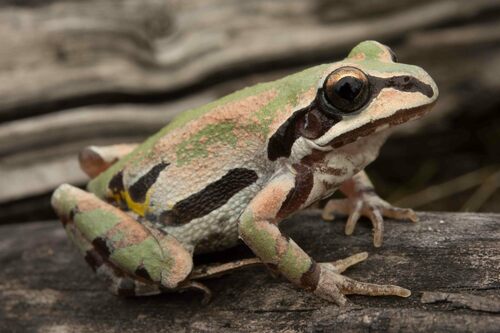
Ornate Chorus Frog
Pseudacris ornata
A hidden gem of the Southern winter, the Ornate Chorus Frog is a bold-patterned 'bandit' that thrives when other species hibernate. Known for its metallic call and vibrant hidden colors, it is a rewarding find for any backyard naturalist.
Quick Identification
Size
2.5 to 3.8 cm (1 to 1.5 inches) in length
Colors
Variable base of rusty red, forest green, or silver-gray; distinct black mask; bold dark spots on sides; hidden yellow or orange wash on the groin.
Key Features
- Dark 'bandit mask' stripe running through the eye to the shoulder
- Large, circular dark spots on the flanks and back
- Vibrant yellow or orange flash colors on the inner thighs
- Robust, rounded body with granular skin
When You’ll See Them
Behavior
The Ornate Chorus Frog is a master of camouflage and one of the more secretive amphibians of the American Southeast. Unlike many of its cousins that spend their time high in the trees, this species is primarily terrestrial and fossorial, meaning it prefers to stay close to the ground or even burrow into loose, sandy soil. They are exceptionally shy and spend most of the year hidden beneath logs, pine straw, or underground to avoid the heat.
These frogs are famous for their 'winter' activity. While most wildlife settles down for the cold months, the Ornate Chorus Frog emerges during the first heavy rains of November or December to begin its breeding season. During this time, males migrate to fish-free temporary ponds, where they emit a sharp, metallic 'peep' that sounds remarkably like a hammer striking a steel anvil. They are sensitive to vibrations; a single heavy footstep can cause an entire chorus to go silent instantly.
EverydayEarth exclusive
Camera Tips
Capturing the Ornate Chorus Frog on camera requires a specialized approach because of their small size and ground-level lifestyle. You must position your camera extremely low—no more than two or three inches off the ground. If you are using a trail camera, look for a 'macro' or close-focus setting, as these frogs are only about an inch long and will appear blurry if the camera is placed too far away. Aim the lens at the edge of a rain puddle, a shallow garden pond, or a damp depression in the yard where water naturally collects after a winter storm.
Lighting is a critical factor for success. Since these frogs are strictly nocturnal and active during the wettest months, you need a camera with high-quality infrared (no-glow) LEDs. Standard white flashes will often cause the frog to retreat immediately. Set your camera to video mode rather than still photos; the movement of the male’s vocal sac inflating and deflating is one of the most interesting behaviors to capture and is much easier for AI software to identify than a static, camouflaged shape on the forest floor.
Timing is everything for this species. Don't bother setting up your gear during dry summer spells. Instead, watch the weather forecast for 'winter warm fronts'—nights where the temperature stays above 45°F and it is raining steadily. This is when the frogs are most likely to move across your yard. If you want to encourage a visit, leave a section of your yard 'wild' with plenty of leaf litter and fallen branches near a low spot, providing the cover they need to feel safe enough to emerge.
Similar Species
Species that look similar or are commonly confused with Ornate Chorus Frog.
Spring Peeper
The Spring Peeper is identified by a dark, thin 'X' on its back, whereas the Ornate Chorus Frog has distinct circular spots and a bolder eye mask.
Southern Chorus Frog
Southern Chorus Frogs usually have three distinct longitudinal rows of spots or stripes, while Ornate spots are more irregular and they lack the Ornate's yellow groin patches.
Frequently Asked Questions
Record Ornate Chorus Frog at your habitat
Connect a camera to start building your own species record — AI identifies every visitor automatically.