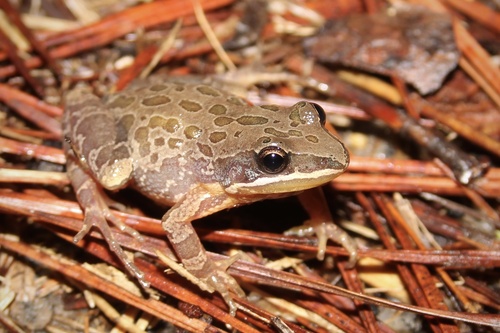
Southern Chorus Frog
Pseudacris nigrita
A hidden gem of the southern wetlands, the Southern Chorus Frog is a winter-loving singer that trades the treetops for the forest floor. Listen for their rhythmic, comb-like call to find these masters of camouflage.
Quick Identification
Size
1.9 to 3.2 cm (0.75 to 1.25 inches) in length
Colors
Tan, grey, or reddish-brown base with three dark longitudinal stripes (often broken into spots) and a distinctive white line along the upper lip.
Key Features
- Three dark stripes or rows of spots along the back
- White line running along the upper lip
- Pointed snout and slender body
- Minimal webbing on the toes
When You’ll See Them
Behavior
The Southern Chorus Frog is a secretive terrestrial resident of the American Southeast. Unlike many of its tree-dwelling relatives, this species spends the majority of its life on the ground, masterfully camouflaged among fallen leaves and low-growing vegetation. They are often described as 'ghosts of the wetlands' because they are far more frequently heard than seen, especially during the cool winter and early spring months when their breeding season peaks.
These frogs are highly sensitive to vibrations and movement. When approached, they will instantly cease their calling and dive into the water or burrow deep into the leaf litter. Despite their shy nature, they are prolific singers. Their call sounds remarkably like someone running a thumb over the teeth of a plastic comb, and when a large group gathers, the sound can be heard from a significant distance.
EverydayEarth exclusive
Camera Tips
Capturing the Southern Chorus Frog on camera requires a specialized approach because of their small size and ground-dwelling habits. For the best results, position your camera just 3 to 5 inches off the ground. Aim the lens toward a 'calling site'—typically a small clump of grass or a half-submerged log at the edge of a shallow, temporary pool. Since these frogs are so tiny, using a camera with a short focal length or a dedicated macro lens will ensure the image isn't a blurry smudge against the mud.
Standard PIR (Passive Infrared) motion sensors often fail to trigger for cold-blooded amphibians because they don't produce enough heat. To combat this, set your camera to 'Time Lapse' mode. Configure it to take a photo every 30 seconds to 1 minute during the hours immediately following a rainstorm. This increases your chances of 'catching' a frog as it emerges to feed or find a mate. If your camera has a 'Sensitivity' setting, turn it to its highest level to catch the slight movement of a hopping frog.
Timing is everything with this species. In the Southeast, the Southern Chorus Frog is most active when other wildlife is hunkered down for winter. Focus your efforts on damp, humid nights between December and March when temperatures are between 45 and 60 degrees Fahrenheit. If you have a backyard rain garden or a drainage ditch that holds water, place your camera there after a heavy afternoon downpour; the combination of moisture and rising humidity is the perfect trigger for their emergence.
Similar Species
Species that look similar or are commonly confused with Southern Chorus Frog.
Upland Chorus Frog
The Upland Chorus Frog has stripes that are more likely to be broken into spots and a distinct dark triangle between its eyes.
Spring Peeper
Spring Peepers have a prominent 'X' mark on their back and larger toe pads for climbing, whereas Southern Chorus Frogs have longitudinal stripes.
Frequently Asked Questions
Record Southern Chorus Frog at your habitat
Connect a camera to start building your own species record — AI identifies every visitor automatically.